Making the business case for a new WMS should be simple — the system improves accuracy, productivity, service levels, and overall warehouse performance. But translating those operational wins into a clear financial justification is often much more complicated. The challenge isn’t whether a WMS delivers value. It’s that the value shows up in different forms, at different times, and not all of it is easily measured in dollars.
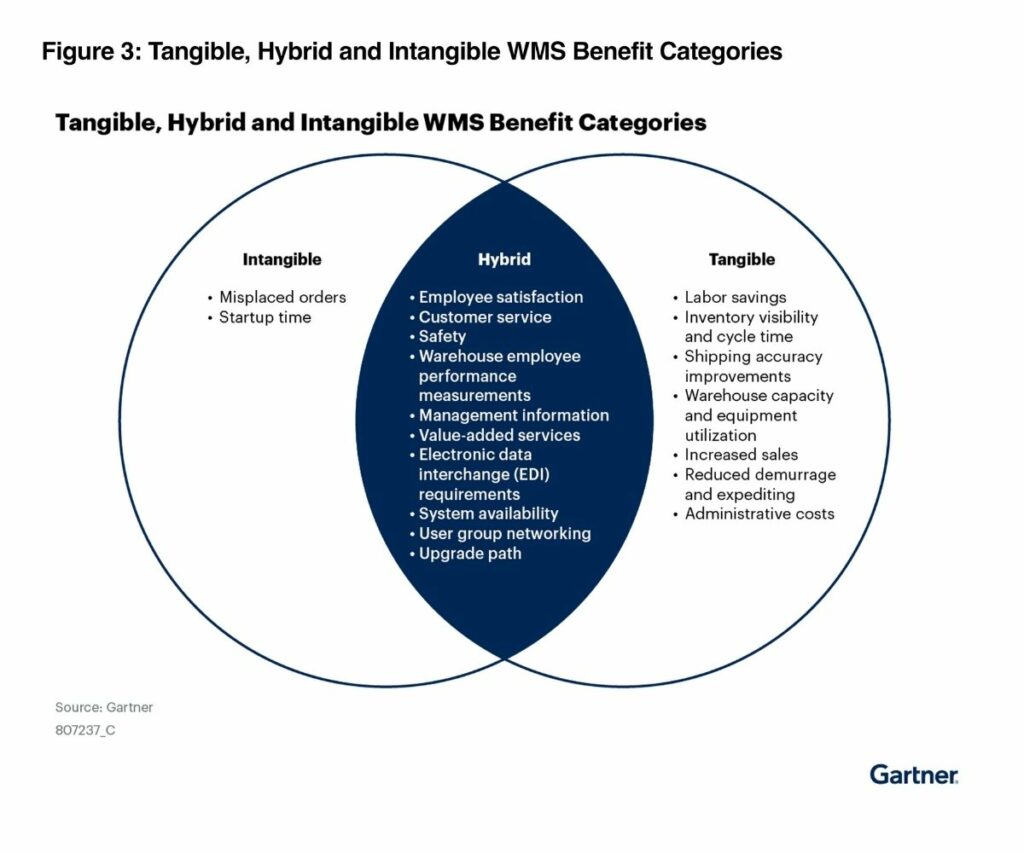
Some WMS benefits are tangible and straightforward to quantify: reduced labor hours, fewer errors, optimized space, faster throughput. Others fall into a “hybrid” zone — where the impact is real but depends on assumptions, modeling, or upstream/downstream effects. And then there are the intangible benefits: stronger brand perception or the increased agility that comes from having a modern, flexible system. These are often the hardest to communicate to executives and stakeholders, even though they play a major role in long-term performance.
Because a WMS influences so many parts of the business — operations, customer experience, financial outcomes, and even strategic growth — its benefits don’t fit neatly into one bucket. And that complexity makes it harder to build a clean, compelling business case.
In this post, we’ll break down the three categories of WMS benefits — tangible, hybrid, and intangible — and show how understanding each one makes it easier to build a balanced, credible, and strong case for a WMS investment.
Upcoming Live Webinar: Use Gartner® Research to Build an Ironclad WMS Business Case
Tuesday, February 17th at 12pm ET
Featuring experts from Made4net, St. Onge, and Zion Solutions Group
We’ll be walking through Gartner’s proven framework, plus real-world implementation expertise that’s helped companies turn “we can’t afford it” into “we can’t afford not to.”
Build a Strong WMS Business Case: Tangible Benefits
Tangible benefits are the easiest part of a WMS business case because they translate directly into measurable financial gains. These are the improvements you can point to with real numbers, clear before-and-after comparisons, and credible ROI calculations.
A tangible benefit is any quantifiable cost savings or productivity gain that results from a specific WMS-enabled change. For example, a modern WMS might streamline inventory management, allowing teams to find, pick, and replenish faster — which reduces labor hours. Or it may improve accuracy, lowering the costs tied to errors, returns, or write-offs. A WMS can also help optimize equipment usage, reducing maintenance or extending the life of material handling assets.
What makes these savings “tangible” is their direct link to operational improvements and their clear monetary value. They’re concrete, measurable, and easy to communicate to stakeholders — which is why they often form the backbone of a WMS ROI model.
The recent Gartner® Report: Create a Strong Business Case for a Warehouse Management System Investment highlights the following WMS tangible benefit categories:
| Category: | Description: |
| Labor Savings | • Labor productivity can improve by 20% to 30%, potentially reducing overtime costs. • Better planning and management allow material handlers to complete tasks within standard work hours. |
| Inventory Visibility and Cycle Time |
• Improvement accuracy up to 99.9%, inventory cycle time reduction.
• Reliable data, maintaining customer service fulfillment. • Better inventory visibility, enabling consignment programs that shift inventory book value to suppliers. |
| Shipping Accuracy Improvements | • Accuracy can virtually eliminate shipping errors. |
| Warehouse Capacity and Equipment Utilization | • Elimination or reduction of outside storage reduces lease, insurance and transportation costs. • Equipment utilization as a nonlinear cost. • Leasing equipment improves utilization and frees up capital. • Selling owned equipment provides a one-time cash inflow. |
| Increased Sales | • Profit from each item sold; unsold items mean lost profit. • Improved fill rates boost sales, benefiting the business case. |
| Reduced Demurrage and Expediting | • Shipping delays incur detention charges, reducing profitability. • Minimizes rush costs by 50-75% through correct initial shipments. • Reduces returns and saves on freight charges and labor. • Boosts customer service credibility. |
| Administrative costs | • Real-time data reduces entry errors and delays. • Boosts productivity. • Savings primarily from labor efficiency. • Additional cost avoidance opportunities, such as supplies. |
Build a Strong WMS Business Case: Hybrid Benefits
Hybrid benefits sit in the gray area between clearly measurable savings and harder-to-quantify strategic gains. They are real, meaningful outcomes of a WMS investment—but their financial impact depends on assumptions, modeling, or downstream effects that may not show up as a direct line item in the P&L.
These benefits often combine both operational improvements and strategic value, making them partially quantifiable but still influenced by factors outside the four walls of the warehouse.
For example, a WMS may improve order accuracy and speed, which directly reduces labor costs (tangible), but it also leads to fewer customer complaints, faster issue resolution, and higher customer retention—outcomes that drive revenue or protect margin but require modeling to estimate. Similarly, improved inventory visibility might reduce safety stock and free up working capital, yet the impact varies based on demand patterns, replenishment strategies, and supplier performance.
According to Made4net’s EVP of Sales and Strategy, Amit Levy, “Hybrid benefits matter because they tell the “bigger” story: how a WMS improves service, reduces risk, strengthens the customer experience, and enables better decision-making.” These outcomes clearly influence financial performance, but require thoughtful analysis and assumptions to translate into a business case.
In short, hybrid benefits bridge the gap between operational efficiency and long-term value creation. They’re persuasive, but they need context, modeling, and narrative to land with executives.
Gartner® Report: Create a Strong Business Case for a Warehouse Management System Investment highlights the following WMS hybrid benefit categories:
| Category: | Description: |
| Employee Satisfaction | • Boosts employee satisfaction and retention. • Improves system usability and reduces turnover. • Lowers orientation costs but may increase labor costs to retain skilled workers. • Training employees is preferable, even if they leave. • Intangible benefit, partially quantified through turnover rate. |
| Customer Service | • Same-day shipment is expected for direct-to-consumer companies. • Efficient order management potentially extends order cutoff times. • Improves customer service and on-time metrics. • Manages inventory, order processing and shipments effectively. |
| Safety | • Better control of forklift congestion and unneeded traffic. • Improves safety. |
| Warehouse Employee Performance Measurements | • Real-time performance feedback motivates employees. • “Don’t expect it if you can’t inspect it.” • Records every transaction, offering extensive reporting. • Doesn’t rely on the error-prone, time-consuming manual logs of paper-based systems. |
| Management Information | • Provides information for the proactive management of daily operations. • Gives access to new categories of previously inaccessible information. • Adds competitive edge. |
| Value-Added Services | • Satisfies special labeling and packaging needs, including barcoding and carton content info. • Streamlines processes. • Essential cost due to customer demands for specific shipment features. • Assesses labor costs against potential revenue loss from unmet customer needs. |
| Electronic Data Interchange (EDI) Requirements | • Satisfies customer EDI requirements. • Detailed advanced shipment notices (ASNs). • Increased labor from manual ASN provision. • Automation of ASN detail by WMS. • Synchronization with business systems for EDI transactions. • Enables special labeling and packaging. • Satisfies growing demand for labeling and packaging. • Cost of WMS is likely less than the potential revenue loss from unmet needs. |
| System Availability | • Increased reliability of technology. • 99+% uptime. • No downtime for maintenance. • Order processing capability despite main system failure. |
| User Group Networking | • User groups and conferences by third-party WMS vendors. • Opportunities for sharing system uses and best practices. • Cross-industry collaboration. • Online communities for cost-effective idea exchange. • Potential improvements in business operations. |
| Upgrade Path | • Continuous improvement with packaged WMS solutions. • Regular vendor upgrades. • Customer-specific modifications in future releases. • Best practices consideration during upgrades. |
Build a Strong WMS Business Case: Intangible Benefits
Intangible benefits are the performance improvements a WMS delivers that don’t show up as direct cost savings, but dramatically strengthen operational reliability, customer trust, and organizational resilience. These benefits often relate to quality, consistency, and predictability.
They may not be tied to a single dollar amount, but they influence every metric that matters for long-term competitiveness, including speed, accuracy, service levels, and workforce performance.
Gartner® Report: Create a Strong Business Case for a Warehouse Management System Investment highlights the following WMS intangible benefit categories:
| Category: | Description: |
| Misplaced Orders | • Reduced costs from efficient order tracking. • Minimized expenses for locating or repicking. • Streamlined storage processes. • Improved customer service. • Lower labor costs. • Shortened delivery cycle times. |
| Startup Time | • Simplification by WMS automation. • Clear instructions on wireless screens. • Remote management of multiple facilities by WMS. • Resource and best-practice sharing across locations. • Online communities and cost-effective idea exchange. • Improvement in business operations. |
Build a Strong WMS Business Case: Look to the Future
As you calculate the tangible, hybrid, and intangible benefit categories of a new WMS, Levy stresses the importance of looking beyond today’s needs and considering how the system supports the business you’re becoming. “The most convincing WMS business cases factor in more than present-day efficiency. They account for the strategic evolutions ahead — expansions, service diversification, and the unknowns that will define the next five years.”
This forward-looking lens is critical, because the true value of a WMS isn’t just in how well it optimizes current workflows—it’s in how effectively it supports new offerings, verticals, customer expectations, and acquisition-driven growth. Operations that treat their WMS as a strategic platform rather than a transactional system gain the flexibility, scalability, and resilience to evolve with the business, not lag behind it.
Whether you’re exploring options for a new solution or ready to begin selection, Gartner research can support your journey. Get a copy of their latest.
Reminder: Live webinar Upcoming!
Webinar: Use Gartner® Research to Build an Ironclad WMS Business Case
Tuesday, February 17th at 12pm ET
Featuring experts from Made4net, St. Onge, and Zion Solutions Group
You’ll learn how to:
- Quantify what feels unquantifiable – Turn operational gains into numbers finance understands
- Speak CFO language – Present ROI they can’t argue with
- Build a multiyear ROI roadmap – Show exactly when benefits materialize
- Measure what matters – Define KPIs that prove value before and after go-live
We’re walking through Gartner’s proven framework, plus real-world implementation expertise that’s helped companies turn “we can’t afford it” into “we can’t afford not to.”
Disclaimer:
Gartner, Create a Strong Business Case for a Warehouse Management System Investment, Federica Stufano, Rishabh Narang and Simon Tunstall, June 4, 2025.
GARTNER is a registered trademark and service mark of Gartner, Inc. and/or its affiliates and is used herein with permission. All rights reserved.
Gartner does not endorse any vendor, product or service depicted in its research publications, and does not advise technology users to select only those vendors with the highest ratings or other designation. Gartner research publications consist of the opinions of Gartner’s research organization and should not be construed as statements of fact. Gartner disclaims all warranties, expressed or implied, with respect to this research, including any warranties of merchantability or fitness for a particular purpose.