Warehouse buyers in 2026 aren’t shopping for core WMS functionality anymore. They want platforms that flex with fast-changing fulfillment models, absorb new automation without a system rebuild, and don’t take six months of training to deliver value. The 2026 Gartner Critical Capabilities for Warehouse Management Systems report puts real numbers behind that shift. Here’s what stood out this year, and where buyers are most likely to misjudge their own evaluation.
Two reports, two different questions
Gartner publishes two companion reports on WMS each year, and it’s easy to confuse them. The Gartner® Magic Quadrant™ for Warehouse Management Systems (WMS) evaluates the WMS market and its vendors as a whole. Product capability matters, but so does global scope, sales and marketing track record, customer satisfaction, and overall vendor viability. The Gartner Critical Capabilities report does something narrower and more in-depth, and for a buyer mid-evaluation, more useful: it looks exclusively at how each specific WMS product performs against 11 defined capabilities, scored separately across five warehouse complexity levels.
Put simply, the Magic Quadrant tells you which vendors are strong and strategically well-positioned. Critical Capabilities tells you which specific product actually fits your warehouse. Gartner designed them to be used together, the Magic Quadrant narrows your shortlist, Critical Capabilities tells you which of those vendors’ products fit your specific operation.
What’s in this year’s report
Gartner evaluated 21 WMS products from 18 vendors for the 2026 report. Each product is scored against the 11 capabilities separately for every complexity level, so a solution that scores well for a Level 2 operation won’t necessarily score well for Level 5, and that’s by design.
The vendor list stayed nearly unchanged this year. That kind of stability isn’t a non-story: it means the differentiation buyers should care about is happening inside the capability scores, not at the eligibility line.
The mistake buyers make before they even open the report
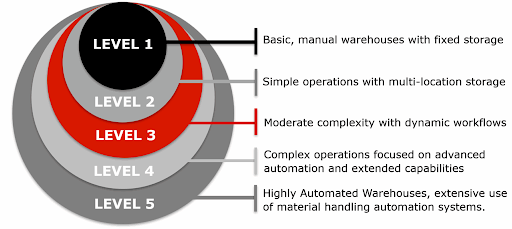
Here’s the part worth sitting with before you get to vendor comparisons: company size and warehouse complexity aren’t the same thing. A large enterprise can run a simple warehouse. A midsize company can run a highly complex one. That’s part of why Gartner stratifies by operational complexity instead of tier language tied to headcount or revenue.
It gets more complicated for companies running more than one facility. A single company might operate warehouses at several different complexity levels at once, a straightforward regional DC alongside a highly automated flagship facility. And within a single warehouse, operations often don’t sit cleanly in one level either.
That raises a real evaluation question: do you shop for your most complex use case, your average one, or something in between? Buyers who anchor on a fixed label like “we’re a Level 3 operation” are usually asking the wrong first question. The better one is which parts of the operation, across which facilities, actually need which capabilities.
Where Gartner is placing its bets
The report’s Strategic Planning Assumptions put dates and percentages on where the market is headed. A few worth watching, quoted directly from the report:
- “By 2029, 75% of WMS buyers will consider user experience as one of the top three selection criteria, up from its current level of 45%, to reduce adoption failures.”
- “By 2031, 75% of WMS vendors will embed AI agents in their applications to eliminate manual exception handling and reduce execution latency.”
- “By 2029, 40% of yard and warehouse deployments will employ vision-AI-enabled autonomous data collection instead of RFID.”
- “Through 2029, systems/technical architecture will equal functionality in importance for new WMS buyers seeking flexibility, adaptability, composability, usability and affordability.”
These are Gartner predictions, not settled outcomes. Some will hold. Some won’t. That’s worth remembering before you build a five-year WMS strategy around any single one of them.
Made4net in this year’s report
In our opinion, many WMS vendors shine in select areas. Made4net stands out for balanced strength across all of them. In fact, Made4net is the only solution to score 3.0 or higher – above the median – across all five Warehouse Operation Use Cases. Here’s why we think that matters. Gartner scores each product on 11 critical capabilities using a five-point scale, where 3 means “Good: meets requirements,” so solutions above 3 are a good fit for that complexity level. Most solutions built to excel at one end of that spectrum fall below 3.0 at the other. Made4net holds steady across all five, a clear indicator of both versatility and reliability. Made4net is designed to scale depending on your distribution complexity level and adapt as business needs change.
Turning the report into practical WMS buying guidance
The report is a valuable starting point, but buyers also need to understand how its findings apply to their own operations. That is where experienced WMS advisors can add important perspective, helping teams interpret the scores, pressure-test assumptions, and connect market research to real-world selection and implementation decisions.
That’s exactly what’s on the table October 7 at 12:00pm ET. Made4net is bringing together four industry experts with deep, hands-on experience helping organizations evaluate, select, and implement warehouse management systems. Made4net experts, Amit Levy & Rishabh Narang, will join independent supply chain consultants from Brecham Group and Alpine Supply Chain Solutions for a live conversation that turns the report’s findings into practical guidance. Together, they’ll share what they’ve learned from years of working with WMS buyers—how to use the research more effectively, which market predictions deserve a closer look, and how to avoid the common missteps that can derail a selection process before implementation even begins.
If a WMS evaluation is anywhere on your roadmap this year or next, this is the conversation that gets you ready for it.
Register for the webinar
Disclaimer:
Gartner, Critical Capabilities for Warehouse Management Systems, Simon Tunstall, Federica Stufano, 30 April 2026.
GARTNER is a registered trademark and service mark of Gartner, Inc. and/or its affiliates in the U.S. and internationally, and MAGIC QUADRANT is a registered trademark of Gartner, Inc. and/or its affiliates and are used herein with permission. All rights reserved.
Gartner does not endorse any vendor, product or service depicted in its research publications and does not advise technology users to select only those vendors with the highest ratings or other designation. Gartner research publications consist of the opinions of Gartner’s research organization and should not be construed as statements of fact. Gartner disclaims all warranties, expressed or implied, with respect to this research, including any warranties of merchantability or fitness for a particular purpose.