By the time a WMS implementation begins, many of the factors that determine success are already in place. The best outcomes don’t happen by accident.

They come from selecting a solution that fits your operation, your growth plans, and your business requirements. While challenges can arise during implementation, most can be traced back to decisions made during the evaluation and selection process. That’s why taking the time to ask the right questions before signing a contract is one of the most important investments you can make.
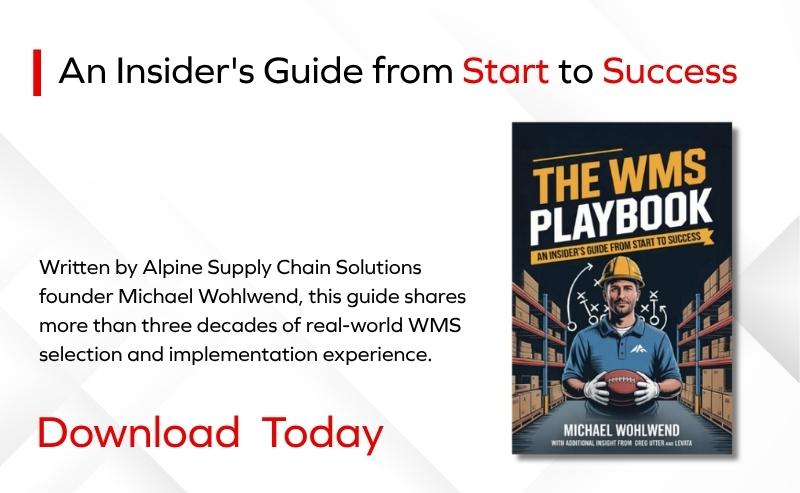
The WMS Playbook: An Insider’s Guide from Start to Success, written by Alpine Supply Chain Solutions founder Michael Wohlwend, is built to support you through the WMS decision making process. Before you sign anything. Before you commit to a budget. Before you fall in love with a demo.
DOWNLOAD THE FULL WMS PLAYBOOK NOW
What trips people up before the project even starts
Alpine has run hundreds of WMS implementations. They sit on the client side of the table, not the vendor’s, so they have no reason to make the process sound easier than it is. Here’s where they see companies go wrong most often, before a project even gets off the ground:
Vague requirements. Teams start evaluating vendors before they’ve documented how their operation actually works, workarounds and all. Not the process on paper, the process on the floor. Ambiguity here means every vendor conversation turns into a guessing game, and every proposal gets compared on features instead of fit.
Feature envy. Most WMS platforms cover the same core functions: receiving, putaway, picking, packing, shipping. The differences show up in the extended features: labor management, dynamic work flows, task interleaving, slotting optimization, MHE integrations, yard management and voice picking.
The book breaks down how to map these against your actual operational complexity, using a simple framework: are you running a basic single-location warehouse, or a highly automated facility with robotics on the floor? That answer should drive your feature list, not the other way around. Paying for capabilities you won’t touch for three years is its own kind of cost overrun.
The cloud vs. on-premise debate, oversimplified. It’s tempting to treat this as settled. Cloud wins, on-premise is legacy, end of discussion. The book pushes back on that.
On-premise still makes sense for some operations, like those with poor internet reliability, strict data sovereignty requirements, or the internal IT muscle to manage it. Cloud makes sense for everyone else, but “everyone else” still needs to understand the difference between single-tenant, multi-tenant, and hybrid architecture before signing anything, since that choice affects security, customization, and cost in ways that aren’t obvious from a sales deck.
Pricing that doesn’t add up. Concurrent users, named users, transaction-based pricing. SaaS versus perpetual licensing. Two proposals that look 30% apart in total cost can land in nearly the same place once you understand what’s actually bundled into the base license versus billed as an add-on.
The book walks through a real example: one vendor’s proposal looks more expensive on the surface, but includes labor management and cartonization that a competitor charges extra for. Comparing sticker price without comparing scope is how companies end up locked into the wrong deal.
Skipping the reference visits. It’s easy to treat vendor references as a formality: a quick call, a few softball questions, check the box. The book lays out what a real reference visit should look like: visiting a customer running the same version of the software, in a similar environment, and asking pointed questions about what broke, how support responded, and what they’d do differently. A vendor who hesitates to set that up is telling you something before you’ve even asked the question.
Contracts signed without legal in the room early enough. Renewal terms, exit clauses, data ownership, SLA specifics. All of it is negotiable if you raise it before signing. None of it is negotiable after. The book recommends looping in legal as you’re finalizing your vendor choice, not after, since companies that wait are the ones who get surprised by auto-renewal clauses and vague termination fees a year in.
Why this matters before you ever talk to a WMS vendor
Every one of these mistakes gets made in the first few months of a WMS project, long before anyone’s thinking about testing or training. By the time implementation starts, the terms are locked, the requirements are set, and the room for correction has mostly closed.
This book exists to help you ask the right questions while you still have leverage. Not after you’ve already committed to a budget, signed a multi-year contract, or discovered that the “must-have” feature you assumed was included is actually a $20,000 add-on.
If you’re in the early stages of a WMS decision, or trying to convince your team to slow down and get the requirements right before the RFP goes out, this is the guide that walks through exactly what to get right, and what it costs you when you don’t.