A panel of practitioners, analysts, and technologists got candid about where the industry is headed. The consensus was more surprising than the disagreements.
Ask four supply chain leaders to debate the future and you expect conflict. What you get instead, if you listen carefully, is a picture of an industry that’s moved past the argument about whether technology matters and landed squarely on the harder question: why is it still so difficult to make it work?
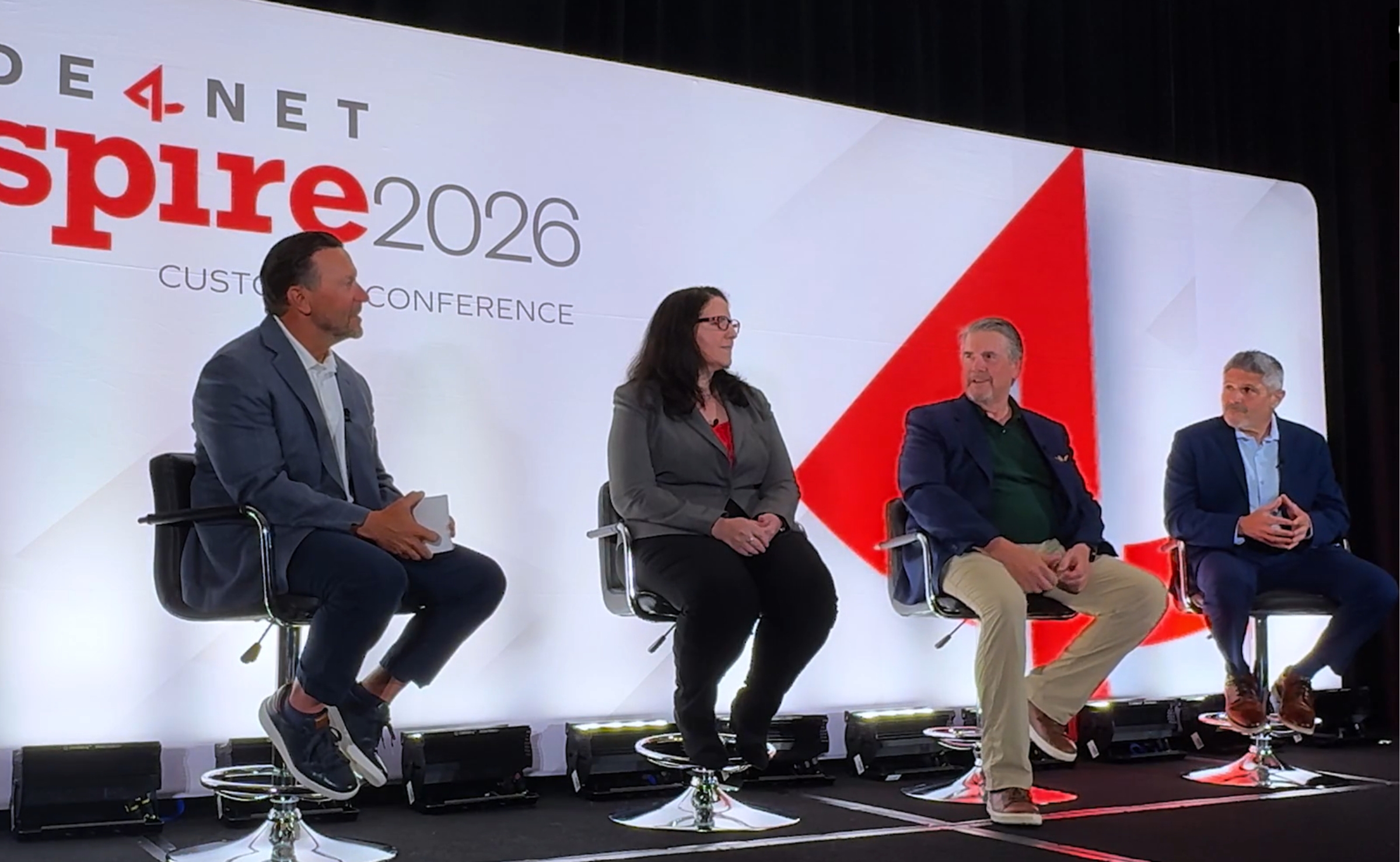
That was the undercurrent running through a recent panel of supply chain practitioners, analysts, and technology executives gathered at Inspire, Made4net’s recent customer conference held May 11–13 in Austin, to assess the state of the industry. Their backgrounds were different. Their conclusions kept converging.
First, meet the panelists:
Michael Wohlwend | Managing Principal | Alpine Supply Chain Solutions
Janet Ortiz | Director | Ryder Supply Chain Solutions
Dwight Klappich | Former Research Vice President and Fellow | Gartner
Edward Prisco | Director, Sales | Locus
Here’s what they agreed on.
- AI is overhyped and underestimated at the same time.
Dwight Klappich, who spent 25 years at Gartner Research tracking technology adoption cycles, put it bluntly: “It’s being overhyped. It’s gonna solve world hunger.” The concern isn’t that AI isn’t powerful. It’s that the industry has been here before. He pointed to RFID as the cautionary tale: companies poured money in during the early 2000s, the technology underdelivered against inflated expectations, and now — even as RFID has matured into something genuinely useful — there’s lasting executive skepticism that makes it harder to fund.
The part that’s being underestimated? Change management. “We could have the best AI in the world,” Klappich said, “but if we can’t get them to use it and continue to use it, it’s just gonna go for naught.”
- Three years ago AI was a pilot. Now it’s in production. The gap is closing fast.
Ed Prisco, whose company, Locus, operates an agentic TMS and last mile delivery platform, pushed back on the idea that AI is still speculative: “Companies are utilizing it at large scale. The adoption has happened so quickly.” The practical applications that are delivering measurable ROI today include route and load optimization, dynamic sequencing, and capacity utilization. Help desk chatbots and document intelligence are live and working at companies like Ryder. What’s still experimental: fully autonomous decision-making, agentic workflows without human oversight.
Janet Ortiz, Director at Ryder Supply Chain Solutions, captured where most practitioners actually are: “We’re trusting and verifying. The humans are still making the decisions.” That’s not resistance. It’s a reasonable position on the adoption curve.
- Most companies don’t have a technology problem. They have an integration problem.
This was perhaps the panel’s sharpest observation, and it came with a reality check from the floor. Klappich described the integration landscape inside the modern warehouse: in 1994, a WMS had five integration points. Today it connects to VLMs, AMRs, conveyors, goods-to-person systems, labor management, time-and-attendance, and an ERP, and that’s before any new automation is added.
“Just because you have an API spec,” Klappich noted, “that can still be weeks of effort to connect.” And the problem doesn’t end at go-live. Firmware upgrades, vendor changes, and system updates break connections that were working yesterday.
Ortiz, who has lived this on the implementation side, was direct: “Don’t underestimate the effort needed to put into understanding the complexity of the data. If you don’t get that right, you’re pouring that on to your operators.” Her team recently spent days resolving data mapping issues to stay on schedule for a go-live. “It always looks good on paper.”
- The orchestration challenge is about software, not hardware.
The panel reached consensus on a point that’s still not fully absorbed in the market: the era of single-agent automation is over. As warehouses add more automation, from collaborative picking robots to autonomous unloaders to goods-to-person systems, the question shifts from “which robot should I buy?” to “how do I get all of these systems to work together in real time?”
“You can’t orchestrate what you can’t see,” Prisco said. Visibility is the starting point. From there, the work is integration, coordination, and optimization across a heterogeneous fleet — a job that no single piece of automation hardware is designed to do. That’s the software layer. That’s where the value is being created and competed for.
- The companies that will lead aren’t the ones with the most technology. They’re the ones that know how to change.
If there was one thing every panelist circled back to, it was this: technology is not the constraint. People and processes are.
Ortiz described it in terms of training versus education. “Training is: push this button, do this, follow this process. Education is: what is this data telling me, and what do I do with it?” The big-bang implementation rollout, where everyone gets trained at once and is expected to retain it, is over. The industry needs continuous learning models that work for a workforce turning over at nearly 50% annually.
Klapick’s call to action: find your early adopter, get them deeply engaged, and let them bring the rest of the organization along. The “why-nots”, the people who will tell you why something won’t work, exist in every organization. “They’re going to retire,” he said, “and we’re going to lose all that tribal knowledge.” The window for managing that transition thoughtfully is narrowing.
The panel’s closing message, distilled by Ortiz: “Don’t boil the ocean. Take practical use cases, start small, and learn with your team. If you wait to be perfect, you’ll never start, because it’s always changing.”
That may be the most honest summary of where supply chain technology stands right now: too important to ignore, too complex to rush, and advancing too quickly to wait for certainty before moving.