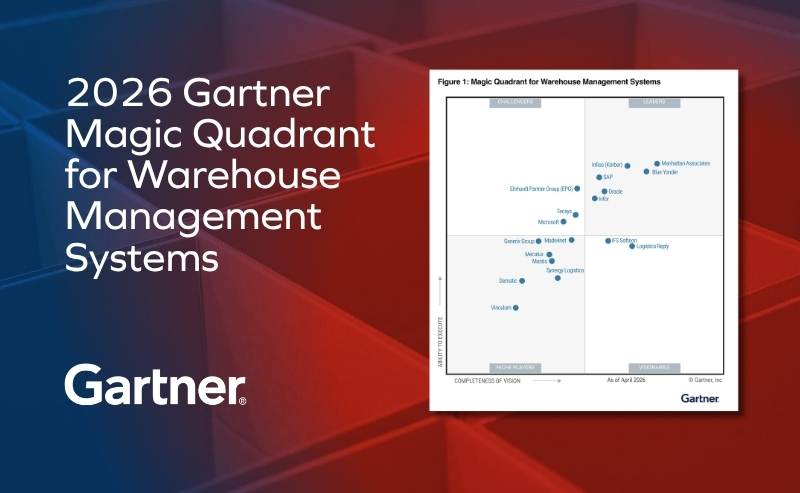
Choosing a WMS means wading through vendor pitches, feature checklists, and conflicting advice. Below, we’ve pulled together the questions buyers ask most, and answered them using data from the 2026 Gartner® Magic Quadrant™ for Warehouse Management Systems (WMS), along with Made4net’s own experience helping companies make this decision.
What is the Gartner Magic Quadrant for WMS, and what does it tell you?
The Gartner Magic Quadrant for WMS is an independent evaluation of vendors in the warehouse management software market, assessing them on completeness of vision and ability to execute. It’s a starting point for building a shortlist, not a final answer.
Gartner’s 2026 report notes that despite being a mature market, “recent macro factors and disruptions have spurred innovation,” with the overall WMS market reaching almost $3.5 billion in 2025.
Made4net has been named in the report for 11 consecutive years. That track record matters less as a badge and more as a signal: an 11-year presence means Made4net has been evaluated against evolving criteria across more than a decade, not just against this year’s snapshot of the market.
Do all WMS vendors offer the same core functionality?
At the core level, all WMS vendors largely offer similar functionality. Gartner is explicit that “there’s near-functional parity for basic core WMS capabilities across WMS providers,” and all 18 vendors in this year’s report cleared a demanding qualification bar.
That means functionality checklists are no longer where vendors differentiate. What separates them now is time to value, total cost of ownership, architecture flexibility, implementation track record, and long-term product viability.
If you’re building an evaluation scorecard, weigh it toward execution and fit, not feature counting. Every vendor on the list can likely do the basics. The real diligence starts after that.
How do I know what level of WMS complexity I actually need?
Most organizations overestimate the complexity of their warehouse operations, and buying more system than you need is one of the costliest mistakes in a WMS selection.
Gartner uses a five-level model to stratify warehouse complexity, and is direct about where most operations actually fall: “globally, the preponderance of warehouse operations are Level 3 or below in Gartner’s warehouse complexity model. Warehouses at Level 3 and below do not require, nor would they normally use, the most advanced functionality.”
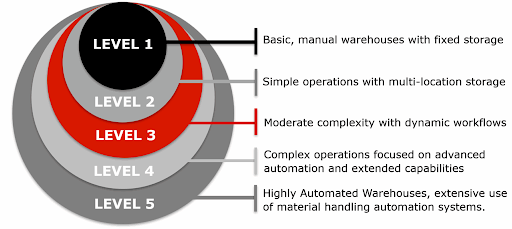
Level 1 — Basic, manual warehouses with fixed storage
Level 2 — Simple operations with multi-location storage
Level 3 — Moderate complexity with dynamic workflows
Level 4 — Complex operations focused on automation and extended capabilities
Level 5 — Highly automated warehouses with advanced material handling systems
Amit Levy, EVP of Sales and Strategy at Made4net, puts it this way: “The best WMS isn’t the one with the most features. It’s the one that aligns best with your strategy.” Map your operation honestly against Gartner’s five levels before you build a vendor shortlist. Your complexity profile should drive the shortlist, not the other way around.
Should a mid-market and large organizations use one WMS across all its facilities?
Mid-market and large organizations don’t need the same WMS configuration everywhere, but ideally the same platform. Multi-site networks typically span a wide range of complexity, and forcing every facility onto identical functionality creates problems in both directions.
Gartner describes this directly: “organizations have warehouse operations that span from very simple Level 1 warehouses to highly complex and automated Level 5 warehouses, and everything in between. While functional depth and breadth are important for the complex operations, simplicity and ease of use are much more compelling needs for Level 1 and Level 2 operations.”
A solution built only for your most demanding site adds unnecessary cost and complexity everywhere else. A solution built only for your simplest sites hits a ceiling as operations evolve. Evaluate vendors on how well they perform in each level of complexity.
Is cloud WMS actually cheaper than on-premise long term?
For simpler operations, a cloud WMS is generally less expensive, at least in the near term. For large or complex environments, the answer gets more complicated. More than 85% of new WMS deals are now cloud, and that trend isn’t reversing.
Gartner cautions that “for larger and more complex environments, WMS cloud pricing is confusing to buyers since a de facto standard pricing model remains elusive, and long-term (10- to 15-year) costs seem unreasonably high to many buyers.”
Treat the cloud decision as multi-dimensional rather than a simple yes or no. Model total cost of ownership over the full expected lifecycle, not just year-one licensing, and ask vendors to walk you through their pricing model in plain terms before you sign anything.
How long does WMS implementation actually take, and what does it cost?
WMS implementation takes longer and costs more than most buyers expect going in. This is one of the most underestimated parts of the decision, and it’s worth pressure-testing with every vendor on your shortlist.
Dwight Klappich, a veteran Gartner Research VP with more than 40 years in supply chain technology, has put a number on it: a typical WMS implementation runs between 4,000 and 12,000 hours and costs anywhere from $250,000 to well over $1 million.
That range exists because scope, complexity, and internal readiness vary enormously between organizations. Ask every vendor for implementation estimates based on your specific environment, not a generic average, and factor internal project management time into your budget alongside the vendor’s professional services costs.
How is AI being used in WMS today, versus roadmap promises?
WMS software is just beginning to leverage AI, with more opportunities on the horizon. It’s worth separating what’s live today from what’s being promised for tomorrow.
Gartner’s assessment: “many vendors have adopted limited forms of basic AI and machine learning to add more sophisticated intelligence to their applications. More recently, some vendors have begun restructuring to enable agentic AI, with many now deploying GenAI to support data retrieval and ease of use.”
Ask vendors for specific, current examples of AI in production, not just roadmap slides, and ask how those capabilities are priced. Gartner notes that AI’s consumption-based pricing models are likely to disrupt the subscription pricing that’s only recently stabilized, so this is a cost question as much as a technology question.
What’s the difference between WMS and ERP, and do I need both?
An ERP manages your business broadly: finance, HR, procurement, and a basic warehouse module. A WMS is purpose-built for the detailed mechanics of running a warehouse: inventory accuracy, pick and pack optimization, labor management, and space utilization.
Many companies start with ERP alone and add a standalone WMS once distribution complexity outgrows what the ERP’s warehouse module can handle. If your warehouse operations are simple and your ERP’s built-in module is keeping up, you may not need a standalone WMS yet. If you’re hitting the limits of what your ERP can do, a WMS becomes the more specialized layer that lets your ERP focus on the rest of the business.
What should I compare when shortlisting WMS vendors?
When shortlisting WMS vendors don’t simply compare feature lists. Since core functionality is now close to table stakes across the market, your comparison should center on fit: how well a vendor’s complexity handling, deployment flexibility, pricing model, and AI roadmap match your actual operation, both today and as it grows.
Build your shortlist criteria in this order: your complexity level across all your facilities, your realistic total cost of ownership over the full contract lifecycle, the vendor’s implementation track record at organizations similar to yours, and how transparently they can show you AI capabilities already in production.
The best WMS isn’t the most powerful one on paper. It’s the one that fits your operation now and has room to grow with it.
Download your complimentary copy of the latest Gartner report here!
Disclaimer:
Gartner, Magic Quadrant for Warehouse Management Systems, By Simon Tunstall et. al, 29 April 2026
GARTNER is a trademark of Gartner, Inc. and/or its affiliates. Magic Quadrant is a registered trademark of Gartner, Inc. and/or its affiliates and is used herein with permission. All rights reserved.
Gartner does not endorse any company, vendor, product or service depicted in its publications, and does not advise technology users to select only those vendors with the highest ratings or other designation. Gartner publications consist of the opinions of Gartner’s business and technology insights organization and should not be construed as statements of fact. Gartner disclaims all warranties, expressed or implied, with respect to this publication, including any warranties of merchantability or fitness for a particular purpose.