
The warehouse management software (WMS) market exceeded $3 billion in 2024 and has a five-year CAGR forecast in double digits. That growth reflects a clear trend—many organizations are actively evaluating or planning to invest in a WMS to meet rising customer expectations, support operational complexity, and enable digital transformation.
But this momentum comes at a time of economic uncertainty, when every investment is under greater scrutiny. At the same time, WMS pricing models are becoming more complex, and the cost of implementation continues to rise. So how can you ensure that your WMS investment delivers value—not just today, but in the years ahead?
The highly anticipated Gartner® Magic Quadrant™ for Warehouse Management Systems (WMS) is here — and it’s packed with insights that supply chain leaders like you won’t want to miss.
We gathered tips from Made4net and industry experts for a discussion on the current state of the WMS landscape, how to make the most of the Gartner® Magic Quadrant™ for WMS report, and what else you should know before investing in a new WMS.
In this article, we’ll cover:
- 2025 Gartner Magic Quadrant for WMS: At a Glance
- Watch Our Takeaways From the 2025 Gartner Magic Quadrant for WMS Report
- Key Questions to Consider As You Review the 2025 Gartner Magic Quadrant for Warehouse Management Systems (WMS) Report
- Expert Advice and Commentary on the 2025 Gartner Magic Quadrant for WMS
2025 Gartner Magic Quadrant for WMS: At a Glance
For this year’s report, Gartner evaluated over 80 WMS providers, but only 17 met the documented inclusion criteria and were ultimately recognized. We’re excited to share that Made4net has been named in the Gartner® Magic Quadrant™ for WMS for the 10th year in a row — a recognition we’re incredibly proud of as we continue to help businesses build smarter, more agile supply chains.
The report highlights how the WMS market is more dynamic than ever, with groundbreaking shifts and exciting innovations reshaping the landscape. Here are our top takeaways from the 2025 Gartner® Magic Quadrant™ for WMS—each one highlighting a trend you can’t afford to ignore.
Watch Our Takeaways From the 2025 Gartner Magic Quadrant for WMS Report:
Key Questions to Consider As You Review the 2025 Gartner Magic Quadrant for Warehouse Management Systems (WMS) Report
The Gartner Magic Quadrant for WMS offers valuable perspective—but it shouldn’t be read passively. These questions help you interpret the report through your own business lens, separating broad market positioning from what actually matters for your warehouse operations.
What Features and Functions Should I Look For in the 2025 Gartner Magic Quadrant for WMS Report?
As demands on warehouse operations continue to grow, today’s WMS buyers are looking for solutions that can do much more than manage inventory and fulfill orders.
According to the report, “Although functionality remains the primary user evaluation criterion, there’s near-functional parity for basic core WMS capabilities across WMS providers.” Customers now focus more attention on the value-adding capabilities that surround core WMS capabilities.
Our take: Today’s WMS buyers are prioritizing platforms that go beyond basics. They seek robust capabilities such as value-added services, labor management, task interleaving, yard management, and dock scheduling. As labor shortages persist, organizations are also turning to automation to fill the gaps—driving a growing demand for WMS solutions that can seamlessly integrate with a wide range of automation technologies, both current and emerging. In addition, buyers are placing greater emphasis on usability, adaptability, and flexibility to ensure their systems can evolve with their business needs and ensuring scalability to support long-term growth.
How Can the Leaders in the Gartner Magic Quadrant for WMS Report Help Operators Manage Volatility?
As market volatility persists, WMS buyers need agile, responsive partners to help them navigate the new normal.
This year’s Magic Quadrant states, “The dramatic changes embodied in ongoing market shifts will require considerable nimbleness and competency as well as investment on the part of vendors. Therefore, in this Magic Quadrant, we place strong emphasis on a vendor’s understanding of these market dynamics and its product strategies to support these needs.”
Our take: Market volatility ramped up with the onset of the pandemic and has shown no signs of slowing down. Ongoing disruptions—from extreme weather events to shifting trade policies and tariffs—continue to put pressure on warehouse operators to adapt quickly and efficiently. As a result, today’s WMS buyers must do more than just evaluate software features; they must closely examine how vendors respond to market change. In our opinion, vendors with a strong global presence are especially well positioned to monitor evolving conditions and stay ahead of the curve.
What are the Benefits of a Cloud-based WMS, Per Gartner’s Report?
WMS buyers are embracing the Cloud, but now they must choose the right model.
According to the report, “Cloud has become the preferred WMS deployment option, with more than 80% of new customers preferring cloud if the economics are reasonable.” However, there is still ongoing debate among vendors and buyers about whether multitenant SaaS is truly superior to dedicated cloud deployments.
Our take: Multitenant SaaS solutions are designed so that multiple customers share the same application infrastructure and code base, while their data remains isolated. This model offers benefits like faster innovation cycles, lower upfront costs, and simplified maintenance and upgrades. For many organizations, especially those looking for rapid deployment and scalability, multitenant SaaS is an attractive option.
On the other hand, dedicated cloud—also referred to as single-tenant or private cloud—gives each customer their own instance of the application and infrastructure. This can provide greater control, customization, and in some cases, enhanced security or performance for highly complex operations.
The choice between these models often comes down to a company’s specific needs around security, flexibility, customization, and IT governance. As the market matures, buyers are being more deliberate in evaluating which deployment model aligns best with their long-term operational and IT strategies.
Choosing between multitenant SaaS and dedicated cloud shouldn’t be a checkbox decision. Vendors should give buyers the flexibility to choose the cloud deployment that fits their needs — not the vendor’s. Because at the end of the day, warehouse operations don’t succeed on standardization. They succeed on precision, performance, and adaptability.
Should Operators Evaluate Their Vendors Based on Cybersecurity?
Cybersecurity is moving to the forefront for WMS buyers.
Cybersecurity has long been top of mind for IT leaders, but only recently has the warehouse sector experienced its first major breaches—turning theoretical risks into real-world consequences. According to the report, “We see greater client concern over cybersecurity. One former and two current WMS Magic Quadrant vendors have been impacted by cyberattacks in the last two years. Two are still impacted: one in back-office functions and the other in some legacy but significant private cloud customer deployments. To date, there have been no reported breaches involving deployments on new public cloud instances supported by hyperscalers.”
Our take: WMS buyers must now go beyond evaluating functionality and scalability; they must also conduct thorough due diligence around data security, access controls, and vendor protocols.
What Costs Should I Be Aware of When Selecting a WMS From the Gartner Magic Quadrant for WMS Report?
Let’s face it—WMS solutions and their implementations have become increasingly expensive. There’s currently a great deal of confusion around how costs are structured, and pricing models continue to evolve. The report states, “Price variability is significant with cloud-based WMSs, where subscription-based pricing models dominate and de facto cross-industry standards are yet to solidify.”
The report also states that, “Flexibility in commercial terms is becoming more compelling to customers as there is a greater focus on affordability. Some vendors are retaining high pricing, while others are aggressively competing on price to gain market share. Still others are offering seasonal software and hardware subscriptions, which are appealing to companies with significant seasonal fluctuations.”
Our take: With no clear, cross-industry standards in place, buyers may find it difficult to make apples-to-apples comparisons. Until more transparency emerges, buyers should be mindful to assess all costs related to the software, including the cost of implementation in addition to subscription fees. WMS buyers should also note the difference in the breadth of software offerings. Some vendors offer more modules and functionality with some supply chain convergence, which also impacts the price accordingly.
How are the Gartner Magic Quadrant Leaders Implementing AI?
As warehouse operations grow more complex, the role of artificial intelligence (AI) in WMS platforms is quickly moving from “nice to have” to essential. According to the report, “Many of the vendors in this Magic Quadrant, including megavendors, are continuing to build out new use cases for various forms of AI, notably most recently GenAI and vision AI.”
Our take: Over time, a vendor’s ability to embed AI in practical, scalable ways will become a major differentiator—separating those who drive innovation from those who simply keep pace. Made4net customers are deploying AI vision technology and Autonomous Mobile Robots (AMRs), functioning intelligent agents that can perceive, adapt, and make real-time decisions. AI-driven technology is no longer a futuristic concept—it’s transforming warehouse operations today.
Expert Advice and Commentary on the 2025 Gartner Magic Quadrant for WMS
As part of our 2025 Gartner Magic Quadrant for WMS analysis, we gathered industry experts for a discussion on the current state of the WMS landscape, including insights from two of the industry’s most influential reports: the 2025 Gartner® Magic Quadrant™ for Warehouse Management Systems and its companion piece, Critical Capabilities for Warehouse Management Systems.
Here are their tips.
WMS Tip #1: Core Capability Parity Is Real—Focus on Fit, Not Just Features
Don’t get distracted by feature checklists—most leading WMS providers offer near-functional parity when it comes to core capabilities. Focus instead on how well the solution fits your operation, supports your growth, and integrates with your ecosystem.
Howard Turner, Director Supply Chain Systems, St Onge, stresses that differentiators today go beyond functionality. He recommends that buyers assess:
- IT strategy and technical architecture
- SaaS deployment and support models
- Cultural fit with the vendor
- Pricing structure
- Ease of training and use
- Quality of the implementation approach
In a mature market with functional parity, these strategic and operational factors often make the difference between a successful partnership and a costly misalignment.
WMS Tip #2: Volatility is the New Norm, Flexibility Is Key—Choose a WMS That Can Adapt with You
Flexibility isn’t just a nice-to-have—it’s essential in today’s unpredictable supply chain environment. Greg Utter, Senior Managing Director, Alpine Supply Chain Solutions, emphasizes that flexibility starts with future-focused design. “What you’re doing today will likely evolve—whether through new fulfillment models like cross-docking, increased compliance requirements, or expanded lot control. When building your WMS requirements, keep your future state in mind and ensure the vendor can scale and adapt with you.” A WMS that supports long-term growth and change will help you respond confidently to whatever challenges come next.
WMS Tip #3: Prioritize Fit, Integration, Usability, and Adaptability
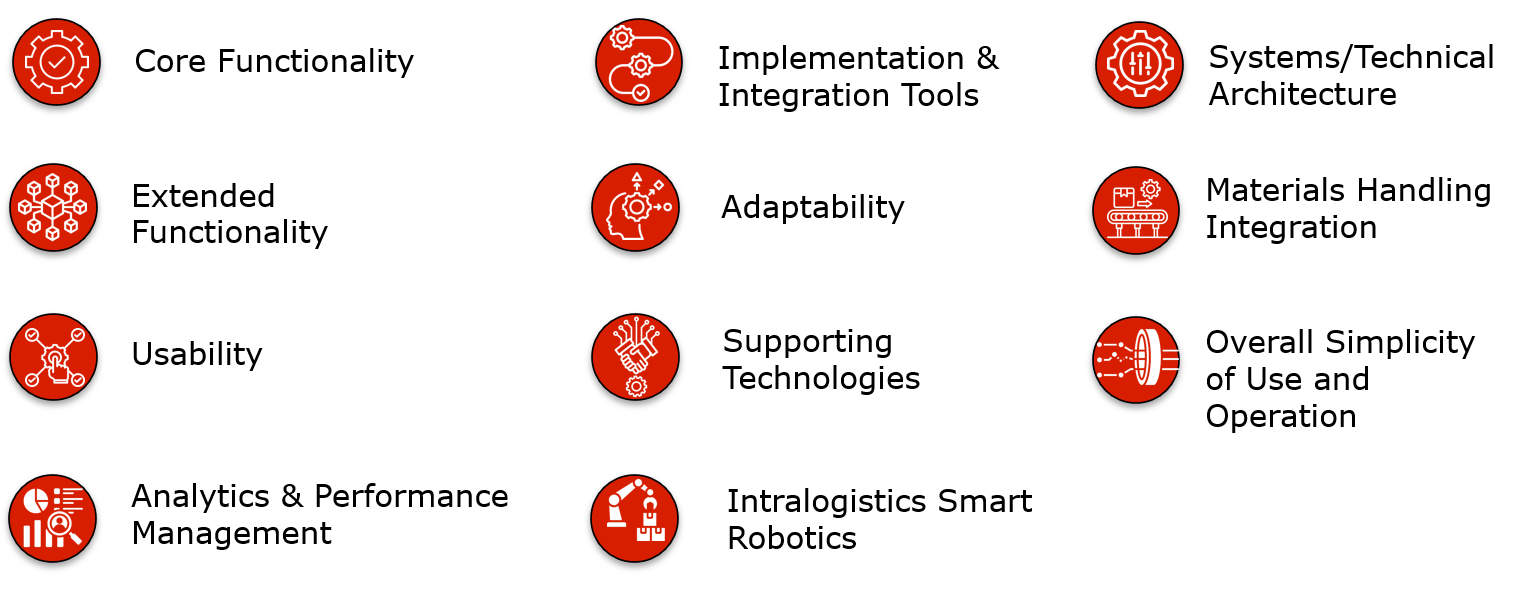
There’s a lot happening in the market right now—but at the end of the day, operations need to stay focused on what matters most for their unique requirements. Still, if our experts had to pick a few Critical Capabilities that are especially important in today’s environment, they would be:
- Implementation and integration tools
Utter emphasized integration as a critical factor—often the most complex part of a WMS project. Buyers should ensure the system can connect seamlessly with existing and future technologies, including material handling equipment, robotics, and broader supply chain systems. - Simplicity of use and operation
All experts agreed: the system must be intuitive and easy to navigate. Minimize clicks, simplify data entry, and ensure warehouse staff can quickly learn the system. A user-friendly interface accelerates onboarding, improves productivity, and contributes to faster time-to-value. - Core and extended functionality
Turner stressed the importance of aligning the WMS with your business-critical processes. He recommends clearly identifying “must-have” vs. “nice-to-have” functionality, and using that framework to evaluate how well each system supports your current and future state requirements. - Adaptability
Amit Levy, EVP of Sales and Strategy, Made4net, called out the need for systems that can evolve with the business—especially in today’s fast-changing environment. Look for platforms that support low-code configuration, templated workflows, and rapid adjustments without heavy vendor dependency.
WMS Tip #4: Focus on Configurability to Drive Speed, Scalability, and ROI
Configurability isn’t just a nice feature—it’s a strategic necessity. Levy explains, “Speed, flexibility, and scalability are essential. When evaluating implementation and integration tools, customers focus on how these capabilities reduce time to value and lower long-term total cost of ownership—key factors in making a WMS investment worthwhile.” A configurable WMS allows you to adapt quickly without costly customizations, accelerating deployment and future-proofing your operations.
WMS Tip #5: Know Your Complexity to Find the Best-Fit WMS—Often at a Lower Cost
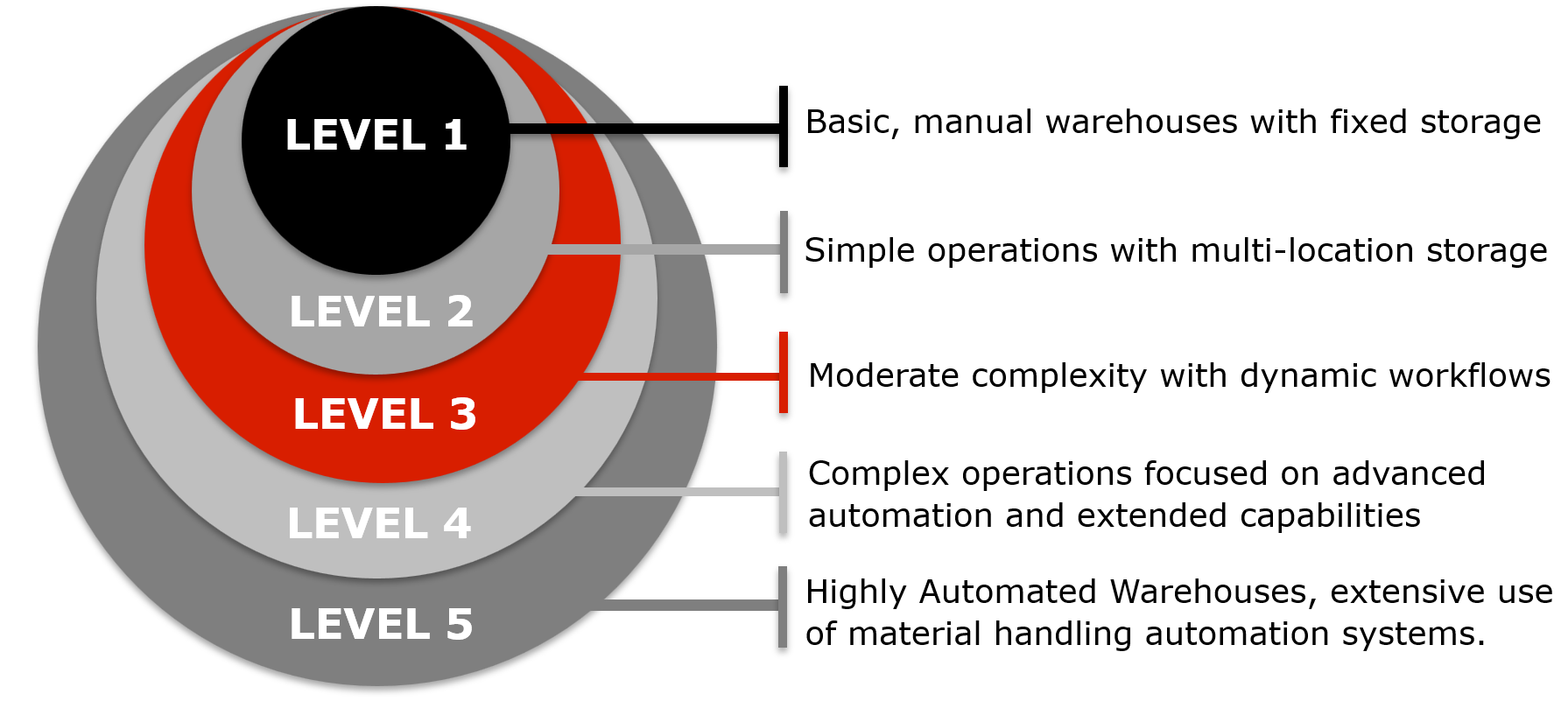
According to Levy, “Buyers are increasingly using Gartner’s Level 1–5 operational complexity model to assess WMS fit. They’re asking whether a solution meets current needs and can scale with future growth and automation goals. The Critical Capabilities framework helps map business priorities to the right system features—whether it’s adaptability and ease of deployment for Level 2–3 operations, or robotics integration and advanced analytics for Level 4–5. At the end of the day, the best WMS isn’t the one with the most features—it’s the one that aligns best with your strategy.”
WMS Tip #6: Build a Business Case Before You Buy
Investing in a new WMS can feel risky, especially amid economic uncertainty—but delaying can be just as costly. Utter advises starting with a solid business case.
Begin by asking some foundational questions:
- Is your current WMS nearing end-of-life or no longer supported?
- Are you facing new regulatory, compliance, or customer requirements that your current system can’t handle?
- Are you expanding into new sales channels, adding automation, or pursuing other growth that your WMS can’t support?
- Are labor challenges making current operations unsustainable?
It’s also critical to understand leadership’s perspective. At the C-level, the key question is often: Can we continue to operate effectively with the current system for the next few years? If the answer is yes, it’s harder to justify the investment—unless future needs clearly demand it.
Evaluate your key drivers, and be cautious of two common pitfalls:
- Inaction: Waiting too long can lead to bigger problems down the line.
- Overreaction: Rushing into a WMS replacement without a clear business case can result in costly, unnecessary projects.
In short, a WMS investment should be strategically driven, supported by data, and aligned with your future-state goals—not just a vague sense that “we need something new.”
Ready to take the next step?
If you’re actively evaluating or planning to invest in a WMS, we invite you to connect with our experts and explore Made4net’s WarehouseExpert™—a powerful, tier-one WMS built to support operations of all sizes with flexibility, scalability, and real-world performance.
Watch the full discussion here
Sources:
*Gartner, Magic Quadrant for Warehouse Management Systems, Simon Tunstall, Dwight Klappich, Rishabh Narang, Federica Stufano, May 1, 2025.
**Gartner, Critical Capabilities for Warehouse Management Systems, Rishabh Narang, Simon Tunstall, Dwight Klappich, Federica Stufano, 28 May 2025
Disclaimer:
GARTNER is a registered trademark and service mark of Gartner, Inc. and/or its affiliates in the U.S. and internationally, and MAGIC QUADRANT is a registered trademark of Gartner, Inc. and/or its affiliates and are used herein with permission. All rights reserved.
Gartner does not endorse any vendor, product or service depicted in its research publications and does not advise technology users to select only those vendors with the highest ratings or other designation. Gartner research publications consist of the opinions of Gartner’s research organization and should not be construed as statements of fact. Gartner disclaims all warranties, expressed or implied, with respect to this research, including any warranties of merchantability or fitness for a particular purpose.