
Most WMS evaluations begin in the wrong place. Teams jump into feature comparisons, vendor demos, and pricing conversations before anyone has asked the more important question: what actually makes this operation complex?
The result is predictable. Either you overspend on a system far more sophisticated than you need, or you underinvest in one that can’t meet your actual demands. In both cases, you end up with a system your team works around—not one that works for them.
The fix isn’t a better feature checklist. It’s a complexity assessment done before the RFP process begins.
What Is Warehouse Complexity Assessment?
Warehouse complexity assessment is the process of systematically evaluating the operational factors that determine what a WMS must actually do—before any vendor is contacted, any demo is scheduled, or any RFP is written. It identifies the specific dimensions of your operation—volume variability, product characteristics, automation dependencies, cycle time requirements, and more—that separate your environment from a generic warehouse.
Without it, you’re writing requirements based on assumption rather than evidence.
Why Is Warehouse Complexity So Hard to Define?
Warehouse complexity is difficult to pin down for a few reasons:
- Shared surface-level processes create a false equivalence. Because most warehouses receive, store, pick, pack, and ship, operations can look similar from the outside while being fundamentally different underneath.
- Complexity is multi-dimensional. It’s rarely one factor—it’s typically the product of several: order profile variability, product characteristics, cycle time requirements, automation dependencies, and adaptability demands.
- Future-state complexity is often ignored. A WMS should have a long lifespan, but most teams assess complexity based solely on current operations—without accounting for growth, acquisitions, new channels, or expanded automation. That gap is one of the most common reasons a WMS becomes a constraint within just a few years.
The 5 Levels of Warehouse Complexity (based on the Gartner® Model)
In its report Use the 10 Dimensions of Warehouse Complexity Before Selecting a WMS, Gartner outlines five warehouse operation use cases ranging from low to high complexity. Understanding where your operation sits today determines the functional depth your WMS must deliver.
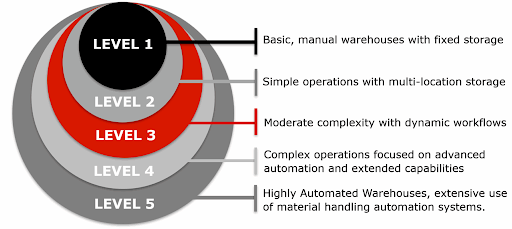
- Level 1 — Basic, manual warehouses with fixed storage
- Level 2 — Simple operations with multi-location storage
- Level 3 — Moderate complexity with dynamic workflows
- Level 4 — Complex operations focused on automation and extended capabilities
- Level 5 — Highly automated warehouses with advanced material handling systems
The gap between a Level 2 and a Level 4 operation isn’t just operational—it fundamentally changes what a WMS needs to do well. A system that’s a strong fit at Level 2 may be entirely inadequate at Level 4, and vice versa.
As Made4net’s Senior Account Executive Jeff Jones puts it: “Not every warehouse needs the same WMS—and that’s the part that gets glossed over in most evaluations. More complex operations demand more functional depth and breadth from the system running them. The problem is that complexity isn’t always obvious. It’s not just square footage or SKU count. Until you understand what actually makes your operation complex, you’re going to have a hard time writing an RFP that gets you the best fit solution.”
What Happens When You Ignore Warehouse Complexity?
Skipping a complexity assessment typically produces one of two outcomes:
Overspending: You select a system far more sophisticated than your operation requires, paying for functionality you’ll never use and absorbing unnecessary implementation complexity.
Underinvesting: You select a system that can’t meet your actual demands, forcing workarounds that erode efficiency and cap your operational ceiling.
The stakes are especially high for operations expanding into automation. As warehouses add robotics, goods-to-person systems, and AMRs, the WMS increasingly has to function as an orchestration layer—not just directing human labor, but coordinating a complex ecosystem of automated systems alongside ERP, TMS, and OMS platforms.
Choosing a system based on today’s feature list without evaluating its integration framework for future automation can leave an operation facing an unbudgeted systems integration project. Complexity misalignment doesn’t just affect day-one performance—it creates a ceiling on where the operation can go.
How Does Complexity Assessment Shape the RFP?
Complexity assessment isn’t a pre-step to the RFP—it’s the foundation of it. Here’s how it changes the process:
- Requirements become specific, not generic. Instead of listing standard WMS capabilities, you define requirements based on what your operation actually demands.
- Vendor evaluation criteria sharpen. You’re no longer measuring vendors against a generic feature matrix—you’re measuring them against your operational profile.
- Demo scenarios reflect reality. Rather than sitting through a standard product walkthrough, you use your complexity profile to build scenarios that require vendors to demonstrate performance under your specific conditions—not an idealized version of them.
- Implementation roadmaps get realistic. Understanding complexity upfront surfaces integration requirements, phasing decisions, and resource needs before they become surprises.
If your operation includes multiple facilities, assess the complexity of each individually rather than applying a blanket WMS across the network. This analysis will reveal whether a tiered or hybrid WMS deployment strategy makes more sense than a one-size-fits-all approach—a consideration that should be built into the RFP from the start.
Submit a generic RFP and you’ll attract generic responses. Define your complexity first, and you give vendors something meaningful to respond to.
How to Assess Your Warehouse Complexity
Understanding your complexity level doesn’t require a lengthy process. Made4net’s warehouse complexity quiz takes less than five minutes and covers 10 multiple-choice questions across the core dimensions of your operation:
- How large is your warehouse operation?
- Which of the following represents your warehouse location mix?
- How complex are the products you store and handle?
- How much variability exists in your order profiles and workflows?
- How adaptable is your operation to business changes?
- What is the scale of your weekly order and inventory movement?
- What type of picking process do you use?
- What kind of inventory control do you have?
- What kind of value-added services (VAS) do you support?
- What is your level of automation?
Your answers are analyzed to produce a complexity score, an estimated range, a tailored summary, and a prioritized list of WMS considerations specific to your operation.
With that in hand, you’re equipped to build an RFP with the precision needed to identify vendors who can actually deliver on your needs—not just the ones who can check the most boxes on a generic feature list.
Ready to assess your warehouse complexity?
[Take the quiz here — it takes less than 10 minutes.]