Every year, the Peerless Research Group survey of warehouse and DC operations gives the industry a chance to step back and take its own temperature. The 2026 Automation Study, conducted in partnership with Modern Materials Handling, captures responses from more than 120 professionals directly involved in purchasing decisions for material handling solutions. What emerges is a picture of an industry in motion: one that recognizes automation as a competitive necessity, is actively investing in new capabilities, but is still working through the uneven reality of where automation has taken hold and where it hasn’t.
Here are the takeaways that matter most and what they mean for operations teams planning their next moves.
The Boom Is Real and the Drivers Are Structural
Global investment in warehouse automation reached approximately $21 billion in 2023, and that number is projected to exceed $90 billion by 2033—a 329% increase over a decade. Those aren’t speculative figures; they reflect genuine structural pressure on the industry. The e-commerce boom fundamentally reset customer expectations around speed and accuracy. Persistent labor shortages have forced operations teams to find scalable alternatives to headcount. And the ongoing pressure to reduce costs while improving throughput has made automation less of a strategic differentiator and more of a baseline operational requirement.
What the 2026 study makes clear is that the industry isn’t just talking about these pressures, it’s responding to them. But the response is not uniform, and the gaps between where automation is deployed and where operations teams want to go next are significant.
Where Automation Has Taken Hold and Where It Hasn’t
The processes that are most fully automated today tend to be at the edges of the fulfillment cycle. Labeling leads with 24% of respondents reporting full automation, followed by reporting at 18% and packaging at 13%. These are meaningful gains, but they also reveal a striking pattern: the core of the fulfillment operation, picking, storage, and retrieval, remains largely manual. Full automation of picking stands at just 12%, storage at 11%, and retrieval at a mere 3%. More than a third of respondents say their picking operation is mostly or fully manual with no current plans to change that, and roughly 30% say the same about storage and packaging.
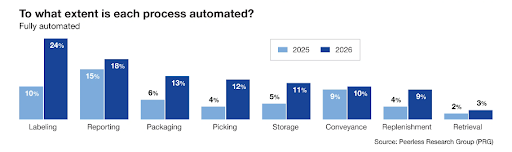
This is worth sitting with for a moment, because it challenges a common assumption. Despite years of industry conversation around autonomous mobile robots, goods-to-person systems, and AI-driven fulfillment, the majority of warehouse operations are still routing human workers through conventional pick paths. The opportunity space and the competitive pressure is concentrated right there in the middle of the operation.
What Equipment Is In Use and What’s Coming Next
On the equipment side, conveyors and sortation systems remain the most widely deployed technology, with 49% of respondents currently using them and 51% planning to upgrade or implement them within the next 24 months. Goods-to-person picking solutions show a nearly identical pattern—48% in use and 51% planning to expand. Weighing, cubing, and dimensioning equipment is deployed at 43%, with 57% planning to add or upgrade these capabilities. These three categories represent the established core of warehouse automation: well-understood technologies with clear ROI, and adoption rates that continue to climb.
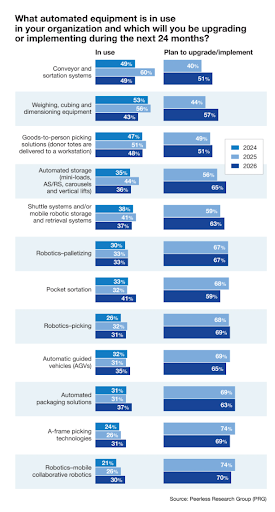
The more revealing story, however, is in the technologies that are gaining traction. Mobile collaborative robotics sits at just 30% current adoption, but 70-74% of respondents plan to upgrade or implement within two years, the largest gap between current use and near-term intent in the study. Robotics-picking shows a similar pattern: 31% in use today, 69% planning to implement. Automated storage and retrieval systems (AS/RS, mini-loads, carousels, and vertical lifts) are at 36% in use with 65% planning to adopt. Even pocket sortation, a technology that was niche just a few years ago, is now at 41% current use with 59% planning expansion.
The consistent theme across these categories is not just adoption, it’s the size of the intent gap. In nearly every emerging technology segment, the share of operations planning to implement far outpaces current deployment. That gap represents both where industry investment is heading and where competitive pressure is likely to intensify over the next 24 months.
What Operations Teams Prioritize When They Invest
Understanding what’s being purchased is only part of the story. Understanding why it gets approved, and what ultimately pushes it across the finish line, reveals how automation decisions are really made.
Durability and reliability top the list, rated very important by 92% of respondents in 2026, a figure that has held consistently high. That isn’t surprising as in a warehouse environment, downtime isn’t an inconvenience, it’s a direct hit to throughput, labor efficiency, and customer commitments.
Even more telling: service and support response time ranks slightly higher, at 95%. That signals a sign in how buyers evaluate solutions. It’s not just about the technology itself, it’s about the partner behind it. When operations are on the line, responsiveness and accountability matter just as much as system performance.
Cost considerations are still critical but the way they’re evaluated is evolving. Total cost of ownership (TCO), ROI, and maintenance costs are rated very important by 77% of respondents, nearly on par with purchase price at 78%. That parity is important. Upfront cost may open the conversation, but it no longer defines the decision. Operations teams are prioritizing long-term value, scalability, and continuity over the lowest initial price.
Beyond cost, buyers are also weighing factors that directly impact long-term performance. Parts availability, risk of obsolescence, and warranty programs all play a meaningful role in reducing operational risk.
Integration, in particular, stands out. With 68% of respondents rating it very important, it’s clear that automation is no longer evaluated as a standalone investment. It must connect seamlessly with existing systems and workflows. In today’s environment, the value of any new solution is defined not just by what it does, but by how well it fits into the broader operation.
None of It Works Without the Core Systems
The automation conversation in warehousing tends to focus on the physical layer, the robots, the conveyors, the AS/RS. But the study’s data on software adoption tells a more fundamental story. Every piece of automated equipment in a warehouse generates data and requires direction. Without the software layer to orchestrate that activity, physical automation investments quickly hit a ceiling.
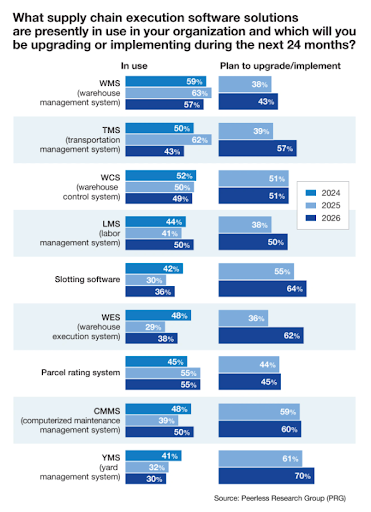
Warehouse management systems lead the software category, with 57% of respondents currently using a WMS and 43% planning to upgrade or implement one in the next 24 months. That level of sustained investment in WMS reflects something important: as operations become more automated and more complex, the need for a sophisticated, real-time management layer grows proportionally. A WMS is not just an order management tool, it is the central orchestration engine that connects labor, inventory, equipment, and fulfillment logic into a coherent operation. As robotics-picking, GTP systems, and AS/RS deployments expand, the WMS becomes the system that makes those investments work together.
Warehouse control systems (WCS) follow at 49% current use, and just over half of respondents are planning to upgrade or implement. Transportation management and labor management systems round out the core stack, each with healthy adoption and strong upgrade intent. Slotting software, an often-underappreciated optimization tool, is gaining meaningful ground—36% current use, with 64% planning to expand. Together, these systems form the connective tissue that determines whether physical automation delivers on its promise or falls short of it.
Investment Is Going Up
The headline budget figure in the study is telling: average planned spend on materials handling equipment and solutions is expected to reach $1.584 million in 2026, up from $1.457 million in 2025. The range of investment is broad. While 29% of companies expect to spend less than $100,000, 16% plan to invest more than $5 million.
Critically, 31% of companies expect their spending to increase over the next year, against just a small share expecting decreases and a significant portion still evaluating. The directional signal is clear: investment in warehouse automation is not plateauing. Operations teams are continuing to allocate meaningful capital to modernization, and the equipment and software categories they’re prioritizing reflect a deliberate push toward greater autonomy, better data visibility, and more resilient fulfillment infrastructure.
The Bottom Line
The 2026 Automation Study confirms that the warehouse and DC sector is in a sustained period of transformation, not a temporary wave of investment, but a structural shift in how operations are built and run. The gap between current automation levels and stated intent is the most important signal in the data. It tells you that the majority of operations teams know where they need to go; the question is whether they have the right systems, partners, and infrastructure in place to get there.
Physical automation without software orchestration, equipment without integration, and investment without strategy will all produce the same outcome: expensive underperformance. The organizations that move forward deliberately, aligning their WMS, WCS, and automation stack before they scale, are the ones most likely to realize the returns this investment environment demands.
Access the full 2026 Automation Study, here.
Source: 2026 Automation Study, Peerless Research Group / Modern Materials Handling, February 2026.