If you’re a food distributor, chances are that sooner or later, a supplier will tell you a lot of product is suspect. The next question is key: which customers received it, and how much is still on your shelves?
Under FSMA 204, the FDA’s Food Traceability Rule, food distributors will have to answer that within 24 hours of an FDA request, from records, not memory. FDA does not plan to enforce the rule before July 20, 2028. That date feels distant. The work behind it isn’t.
FSMA 204 requires companies that manufacture, process, pack or hold foods on the FDA Food Traceability List to record key data elements (KDEs) at critical tracking events like receiving and shipping. The list includes leafy greens, fresh-cut produce, shell eggs, soft cheeses and certain seafood. For food and grocery distributors, much of that data is created at the dock door and the pick slot. How you plan to capture it is a decision to make now.
What does FSMA 204 ask of a food distributor?
FSMA 204 asks you to know where each lot came from and where it went, and to prove it fast. Records tie to a traceability lot code. When the FDA asks, you have 24 hours, or a reasonable time the FDA agrees to, to provide the data. During an outbreak, recall or other public health threat, the information must come as an electronic sortable spreadsheet, with limited exceptions for certain small farms and small retail or restaurant businesses. You must keep the records for two years.*
But 24 hours is a regulatory window, not an operational target. Most recalls don’t begin with an FDA auditor. They begin with a supplier call, customer inquiry, or quality issue that demands immediate answers, not 24 hours later.
No single system delivers that. Traceability spans growers, manufacturers, distributors and retailers, and every handoff has to pass clean data to the next.
What are the two ways to prepare for FSMA 204?
Partner with a traceability platform. Some distributors, especially larger ones, are working with a platform such as iFoodDS to manage data exchange with trading partners, supplier onboarding and reporting. Dan Waters, Director of Strategic Accounts at Made4net, describes it as “a self-service for the large guy,” where “anybody in that chain can say, where did I get it?”
Manage it in-house. Others will use existing systems and internal processes. According to Waters, “The pull is cost. The risk is the 24-hour window.” Without a platform’s dashboard, can you assemble the records in time? In many warehouses the fallback is manual, meaning a mix of clipboards and spreadsheets.
Neither route is complete on its own. A distributor can use a platform and still have blind spots within the warehouse.
What does the warehouse have to do for either path to work?
Waters frames the question this way: “Are you prepared to track cradle to grave through the four walls of your operation to then connect to all the FSMA compliance systems that you’re going to have on both customers and on suppliers?”
In practice, the warehouse has to capture accurate data at receiving, keep it intact through storage and picking, and record exactly which lots left on which orders. There are issues to be mindful of within both inbound and outbound processes.
Inbound: capture the data at the dock door
At receiving, FDA requires these KDEs for each lot: the traceability lot code, product description, quantity and unit of measure, receiving date, where the food was received, the immediate previous source, the lot code source, and a reference document such as a purchase order.**
Waters stresses that receiving has to do more than log a delivery. “You can’t just receive a truckload of lettuce,” he says. Beyond the required elements, he describes capturing expiration, temperature and any visual or sensory inspection results at the dock, and being able to report and share that data.
Outbound: decide how lots leave the building
Inbound is the easier half. Outbound is where things can get tricky.
Warehouses rotate stock the way you do at home. “You put the old stuff up front, you put the new stuff in the back,” says Waters. The trouble starts when a nearly empty pick slot gets refilled with a new lot. Now two lots sit where pickers pull. Waters put it this way: “Did they put the two gallons of milk in the same fridge, and when a kid comes to the fridge, it’s just random luck which gallon he takes, the new one or the old one?”
The shipping record has to tie each lot code to the quantity and unit of measure, the product description, the immediate subsequent recipient, the location shipped from, the ship date, the lot code source, and a reference document such as an order number.*** When lots share space, distributors generally have three ways to make that work:
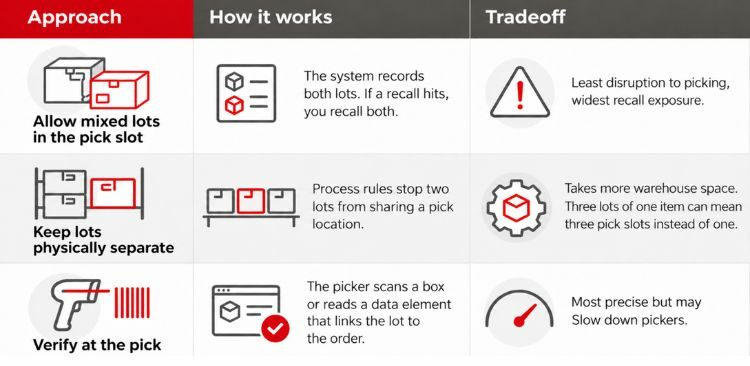
“There’s no one-size-fits-all,” says Waters. The right answer depends on how you ship. “Are you sending pallets of one item, or 37 different items on a pallet?” As Waters explains, “That all goes back to operationally, how was that pallet built?”
What does a recall look like when the warehouse is ready?
A ready warehouse can answer four questions from its own records, quickly:
- When, and from whom, was the lot received?
- How much of it shipped, on what dates, and to which customers?
- How much is still on hand, and where is it?
- Can the remaining inventory be blocked from allocation to new orders?
The rule requires the records. Holding the remaining stock is the action those records make possible.
Waters offers a hypothetical of what that looks like: “I can in a second’s notice go to the computer and say, that lot was received on this day. 727 cases were shipped to these 14 different customers. And I have 195 still in my warehouse that I’ll now quarantine and freeze, so it can’t be allocated against orders.”
The test is whether your warehouse data can answer those questions inside that window, without rebuilding the picture from paper and spreadsheets.
Why act now if the date might move?
The compliance date has shifted before, and Waters thinks it could move again. But waiting on the date misses the point.
Traceability changes how work moves through a warehouse. If compliance costs you efficiency, you want to find out while you can still adjust. “If I was going to take a 5% operational hit to comply, I’d sure want to have a plan… whether it’s 2028 or not, you need to know what compliance looks like in motion.”
The stronger reason doesn’t depend on the date. A lot you can’t trace quickly is a brand and safety problem the day a supplier calls, whether or not FDA is enforcing. And any change to how your warehouse handles lots takes planning and testing, which is easier before a request arrives than during one.
Where does a WMS fit in FSMA 204 readiness?
A WMS does not make a distributor FSMA 204 compliant by itself. Compliance spans suppliers, partners and processes. A traceability platform is only as good as the data it receives, and the WMS is where much of that data gets created and controlled.
But it’s important to note that not every WMS will set you up for FSMA 204 compliance.
Three questions separate one that can support FSMA 204 from one that can’t:
- Does it track lot and expiration at every location, from receiving through picking?
- Can it show when two lots share a pick location?
- Can it trace a lot forward to every customer that received it?
Made4net’s WarehouseExpert WMS manages lots through receiving, storage and picking, and records which lots shipped to which customers.
How ready is your warehouse?
Five questions to ask about your current operation:
- Can we capture lot, expiration and receiving data at the dock for every inbound load?
- Can we tell which lot sits in each pick location, including when two lots share one?
- Can we trace any lot to every customer that received it?
- Can we quarantine the remaining inventory of a lot so it can’t be allocated to orders?
- Can we pull all of this together within 24 hours without a spreadsheet scramble?
If any answer is “not sure,” start there.
Talk through your warehouse plan
Whether you rely on a traceability platform or build your own approach, the work starts inside your four walls. Talk with a Made4net warehouse expert about how your lots flow today, where the gaps are, and which outbound approach fits your business.
Plan Your FSMA 204 Warehouse Strategy
FAQ
What is FSMA 204?
FSMA 204 is Section 204 of the FDA Food Safety Modernization Act, known as the Food Traceability Rule. It requires companies that handle foods on the Food Traceability List to keep lot-level records of key data elements at critical tracking events and to provide them to FDA on request.
Does a WMS make a distributor FSMA 204 compliant?
No. A WMS can’t cover supplier data, trading partner exchange or reporting on its own. What it can do is create and control the lot-level records inside the warehouse, which everything else depends on.
Do distributors need a traceability platform like iFoodDS?
No. The rule sets recordkeeping requirements, not a specific system. Larger distributors often use a platform to exchange data with partners, and others build their own process. Either way, the warehouse has to capture accurate lot data.
When is the FSMA 204 compliance date?
FDA does not plan to enforce the rule before July 20, 2028. The date has moved before, so check FDA’s Food Traceability Rule page for updates.