A single recall event. A missed expiration date. A shipment that left the facility without proper lot documentation. In food distribution, the margin for error is razor thin and the consequences of getting it wrong extend well beyond a customer complaint. Regulatory action, retailer chargebacks, and brand damage can follow.
The difference between operations that absorb these risks and those that get blindsided by them often comes down to one thing: the right software, including a robust food and beverage Warehouse Management System (WMS), configured for the specific demands of food distribution.
In this article, we’ll cover:
- What is food supply chain software?
- What are the 5 types of food supply chain software?
- The benefits of effective food supply chain distribution software
- Key food supply chain software features for distribution
What is Food Supply Chain Software?
Food supply chain software is a category of technology solutions designed to manage, monitor, and optimize the movement of food products from origin to end consumer. These systems address the unique challenges of food distribution — including perishability, regulatory compliance, traceability requirements, and demand volatility — by providing real-time visibility, automated workflows, and integrated data across every stage of the supply chain.
Unlike general-purpose supply chain tools, food supply chain software is built to handle the specific demands of the food and beverage industry: lot and batch tracking, expiration date management, food safety compliance, and recall readiness.
“The food and beverage industry operates under a level of complexity that generic supply chain software simply wasn’t designed for. When you’re managing perishable goods across multiple facilities, with strict regulatory requirements and razor-thin spoilage tolerances, you need systems that understand the problem — not systems you’ve retrofitted to handle it.”
— Amit Levy, EVP of Sales and Strategy, Made4net
A well-configured stack of these solutions helps food distributors operate with greater accuracy, reduce waste, and maintain the integrity of perishable products at scale.
What are the 5 Types of Food Supply Chain Software?
Food supply chain operations rely on several distinct categories of software, each addressing a different functional layer of the distribution process. Understanding how these systems work — individually and together — is essential for building a technology stack that supports food safety, operational efficiency, and long-term scalability. Here is an overview of the five primary types:
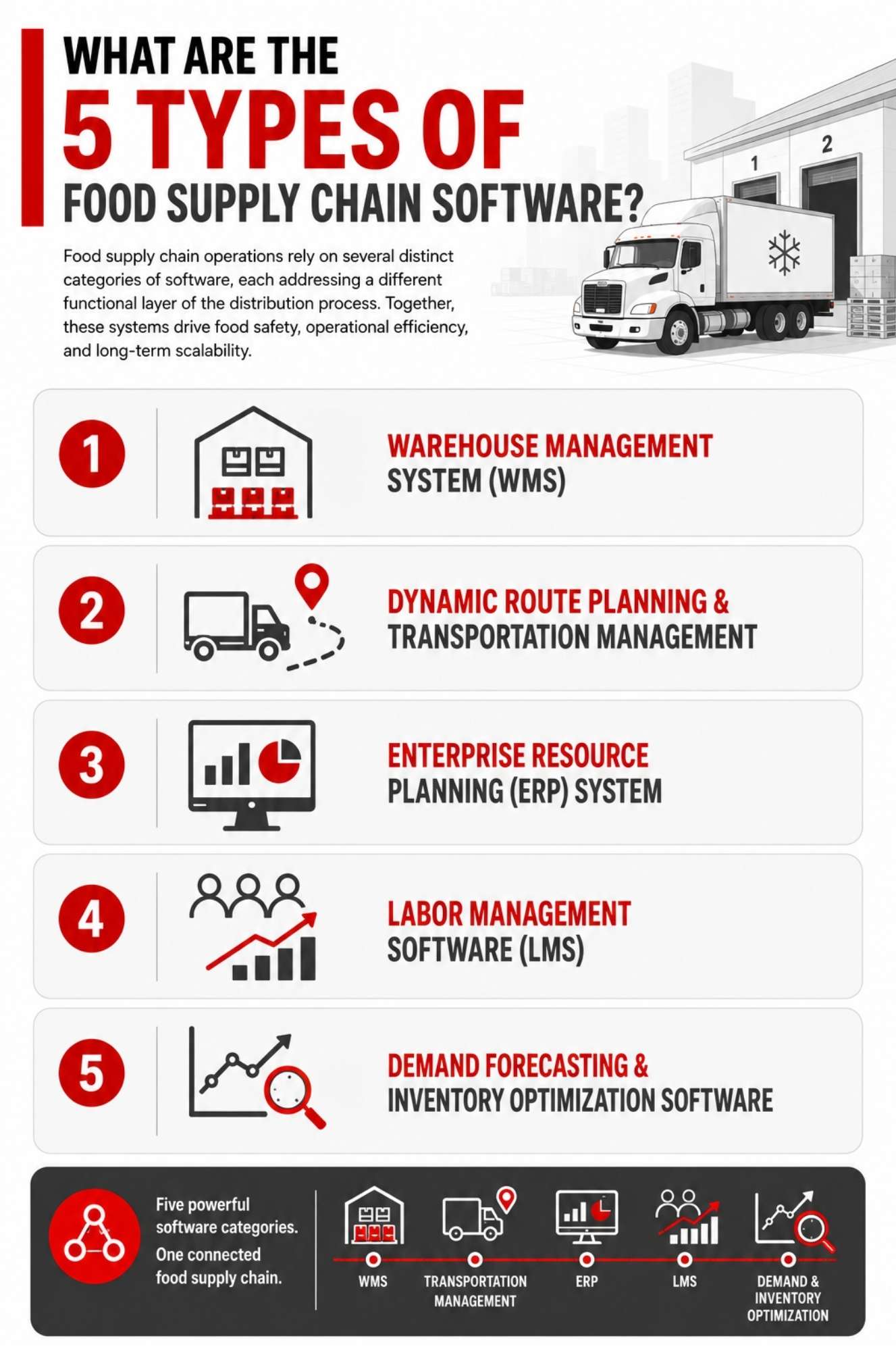
- Warehouse Management System (WMS)
A WMS is the operational core of food distribution. It manages inventory tracking, storage optimization, and order fulfillment within the warehouse environment, while enforcing food-specific requirements such as FIFO/LIFO rotation, expiration date monitoring, and lot-level traceability. For food distributors handling high SKU counts, temperature-sensitive products, or complex slotting requirements, a purpose-built food and beverage WMS is a foundational investment.
Traceability is where the WMS earns its keep from a compliance standpoint. A well-configured WMS tracks ingredients, raw materials, and finished products at the lot and batch level — creating the detailed audit trails required by the FDA’s Food Safety Modernization Act (FSMA) and enabling rapid, precise response in the event of a product recall. In an environment where a single contamination event can affect thousands of SKUs across multiple distribution points, native traceability isn’t a nice-to-have. It’s a requirement. Some operations supplement WMS traceability with dedicated compliance tools, but for most food distributors, a purpose-built WMS with integrated traceability is the right foundation.
- Dynamic Route Planning & Transportation Management
Optimizing delivery performance in food distribution requires the ability to account for real-time variables like traffic, weather, customer time windows, vehicle capacity, and order priority. For some operations, that means implementing a full Transportation Management System (TMS) to manage the entire transportation lifecycle, from carrier selection and load tendering to freight audit and settlement. But for food distributors running their own fleets — particularly those focused on local or regional delivery — a dedicated route optimization solution may be all that’s needed to achieve meaningful cost reductions and service level improvements. Purpose-built route optimization software plans the most efficient delivery routes, adjusts dynamically as conditions change, and integrates with warehouse and order management systems to ensure a seamless handoff from fulfillment to final delivery.
- Enterprise Resource Planning (ERP) System
An ERP system for food and beverage companies integrates procurement, production planning, quality control, financial management, and customer order management into a single platform. It provides executive-level visibility across the business and ensures that supply chain decisions are connected to financial outcomes. While an ERP is not a substitute for a WMS or TMS, it serves as the system of record that ties operational data to broader business performance. Many food distributors run a WMS and TMS in parallel with their ERP, with real-time data synchronization between systems.
- Labor Management Software (LMS)
Labor is typically the largest controllable cost in a food distribution operation — and one of the most difficult to manage without the right tools. A Labor Management System gives operations leaders visibility into workforce productivity at the individual, team, and facility level, using engineered labor standards to measure performance against realistic benchmarks rather than historical averages. In food distribution, where throughput demands fluctuate with seasonality and promotional cycles, LMS enables dynamic task assignment, workload balancing, and real-time performance monitoring — so managers can identify bottlenecks and reallocate resources before they affect order fulfillment. Over time, the data generated by an LMS creates the foundation for continuous workforce optimization, reducing overtime costs, improving retention through fairer workload distribution, and surfacing training needs before they become productivity problems.
- Demand Forecasting & Inventory Optimization Software
Demand volatility is one of the most persistent challenges in food distribution. Seasonal fluctuations, promotional spikes, and shifting consumer preferences can create significant inventory imbalances — leading to either stockouts or excess inventory that spoils before it moves. Demand forecasting software uses historical data, market signals, and increasingly AI-driven models to generate more accurate demand predictions. When paired with inventory optimization tools, it helps distributors maintain leaner, fresher inventory positions while ensuring product availability across their fulfillment network.
The Benefits of Effective Food Supply Chain Distribution Software
The operational impact of the right food supply chain software extends well beyond the warehouse walls. Industry data points to WMS ROI typically ranging 15–25% annually, with most operations reaching payback within 12–24 months — and measurable improvements often visible within the first 60–90 days of go-live. Here is what that looks like across the operation:
Minimize Inventory and Fulfillment Errors
In food distribution, a picking error isn’t just a customer service problem — it can trigger compliance violations, retailer chargebacks, and wasted product that never makes it back into sellable inventory. Real-time tracking and automated workflows eliminate manual data entry, enforce correct pick sequences, and flag discrepancies before they leave the facility. The downstream effect is fewer returns, fewer chargebacks, and a measurable improvement in order accuracy that compounds over time.
Maximize Labor Efficiency
Labor is typically the largest controllable cost in a distribution operation — and one of the hardest to manage without visibility. Food supply chain software gives operations leaders real-time insight into individual and team productivity, enabling smarter task assignment, workload balancing, and performance monitoring. The result: better throughput without proportionally more headcount. Well-implemented systems commonly reduce labor requirements by 10–30% through efficiency gains alone — a meaningful number in an environment where overtime costs and turnover are persistent margin pressures.
“Labor is where we see some of the fastest ROI in food distribution. When you give operations leaders real visibility into what’s happening on the floor, they make better decisions — and those decisions add up quickly.”
— Amit Levy, EVP of Sales and Strategy, Made4net
Reduce Inventory Shrinkage and Spoilage
Shrinkage and spoilage are direct hits to margin — and in food distribution, they’re often the result of poor visibility rather than poor processes. Advanced inventory management enforces FIFO and LIFO rotation automatically, tracks lot-level expiration dates, and generates alerts when product is approaching its best-before threshold. Operations that move from manual tracking to automated expiration management consistently see meaningful reductions in write-offs — product that previously aged past its window gets flagged and moved before it becomes a loss.
Drive Continuous Cost Savings
The inefficiencies embedded in manual or legacy systems don’t stay flat — they compound. Excess labor hours, mis-shipments, unplanned overtime, unnecessary carrier costs, inventory write-offs: each one erodes margin individually, and together they create a cost structure that’s difficult to diagnose and harder to fix without data. Food supply chain software creates a continuous improvement loop by surfacing where inefficiencies occur and enabling the process refinements that reduce them — delivering cost savings that build on each other over time rather than plateauing after the initial implementation lift.
Seamlessly Manage Seasonal and Promotional Demand
Food distribution is inherently seasonal — and volume spikes from promotions, holidays, or weather events can stress operations that aren’t built to absorb them. The right software gives teams the tools to anticipate demand variability rather than react to it after service has already suffered. Configurable workflows allow rapid adjustments to slotting strategies, labor deployment, and fulfillment priorities — so when volume surges, accuracy and speed don’t have to give way.
“Seasonal peaks are where underprepared operations get exposed. The distributors who handle them well aren’t necessarily bigger — they just have better visibility and more flexible systems underneath them.”
— Amit Levy, EVP of Sales and Strategy, Made4net
Support Business Growth and Expansion Growth creates complexity: new customers, new SKUs, new facilities, new geographies. Food supply chain software built for scale handles that complexity through configurable business rules, multi-site management, and the architecture to sustain performance as transaction volumes climb. The goal is a platform that grows with the business — not one that needs to be replaced every time the operation takes a meaningful step forward.
Key Food Supply Chain Software Features for Distribution
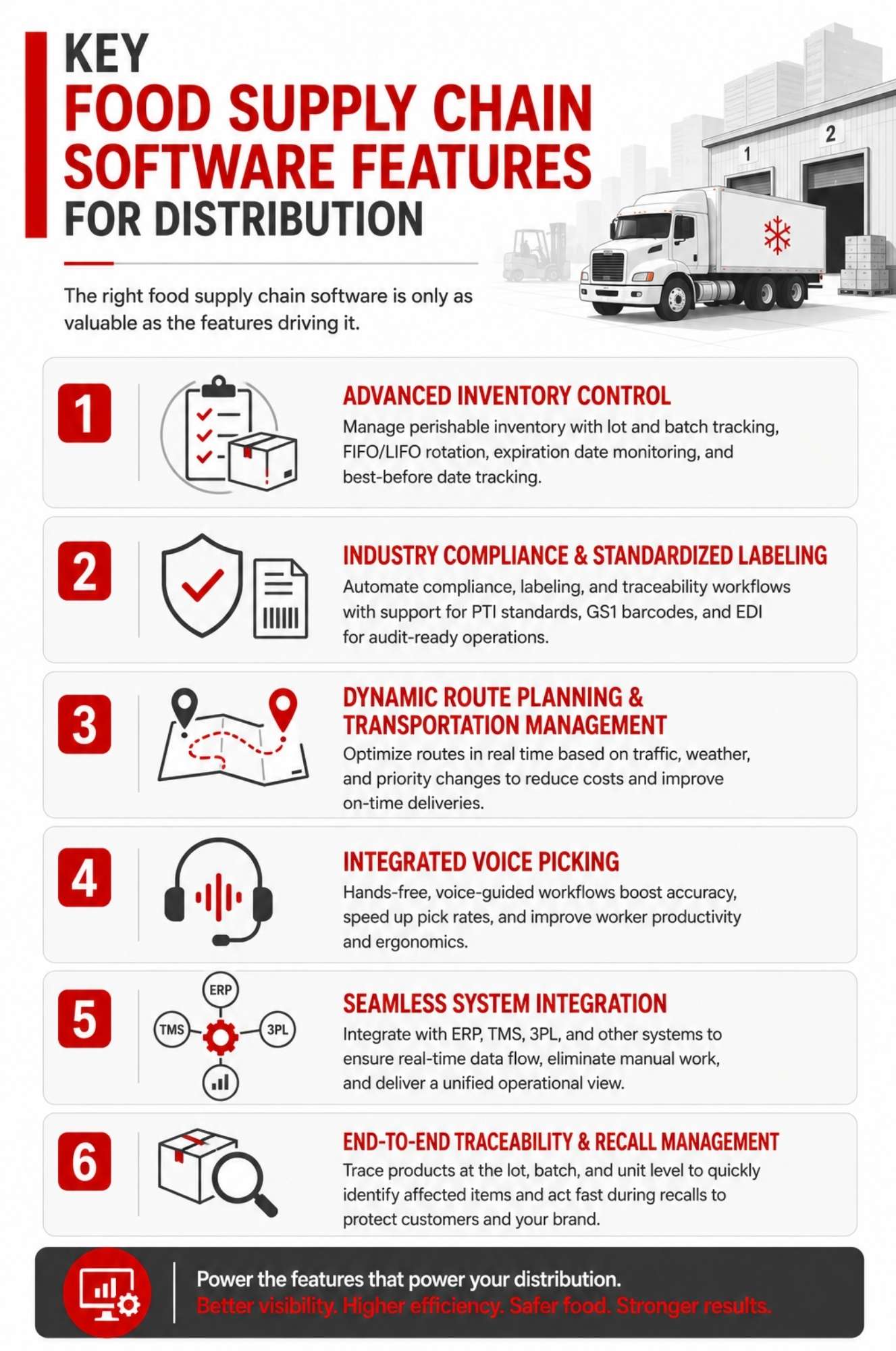
The right food supply chain software is only as valuable as the features driving it. Here are the six capabilities that matter most in food distribution:
Food Supply Chain Software Feature #1: Advanced Inventory Control
Advanced inventory control enables precision management of perishable goods through lot and batch tracking, FIFO/LIFO rotation enforcement, expiration date monitoring, and best-before date tracking. In practice, this means the system is making rotation decisions automatically — not relying on a warehouse worker to remember which pallet arrived first. For high-SKU operations handling temperature-sensitive products, that automation is the difference between consistent freshness and preventable spoilage.
Food Supply Chain Software Feature #2: Industry Compliance & Standardized Labeling
Staying compliant in food distribution requires more than good intentions — it demands automated, auditable processes. Compliance and labeling capabilities automate documentation, labeling, and traceability workflows, reducing the risk of manual error. Support for Produce Traceability Initiative (PTI) standards, GS1 barcode formats, and Electronic Data Interchange (EDI) ensures consistent, standards-compliant communication at every node of the supply chain. When a regulatory audit or retail compliance check arrives, the documentation is already there — not assembled under pressure.
Food Supply Chain Software Feature #3: Dynamic Route Planning & Transportation Management
Dynamic route planning optimizes delivery performance by accounting for real-time variables including traffic, weather, and shifting order priorities. The ability to adjust routes dynamically — rather than executing against static plans — reduces transportation costs, improves on-time delivery rates, and helps maintain cold chain integrity for temperature-sensitive products. For food distributors, where a delayed delivery can mean spoiled product and a failed retailer SLA, that flexibility isn’t a nice-to-have.
Food Supply Chain Software Feature #4: Integrated Voice Picking
Voice picking integrates hands-free, voice-guided workflows directly into the order fulfillment process. By eliminating paper-based pick lists and reducing the cognitive load of visual scanning, voice picking increases accuracy, accelerates pick rates, and improves worker ergonomics in fast-paced warehouse environments. In operations where labor throughput directly determines fulfillment capacity, the productivity gains from voice picking show up quickly — and they compound as workers build familiarity with the system.
Food Supply Chain Software Feature #5: Seamless System Integration
A food and beverage WMS should not operate as an island. Seamless integration with ERP systems, TMS platforms, third-party logistics applications, and other enterprise tools ensures that inventory, order, and shipment data flows in real time across the organization. Without it, teams spend time manually reconciling data between systems — time that should be spent running the operation. With it, decision-makers get a unified operational picture that’s accurate, current, and actionable.
Food Supply Chain Software Feature #6: End-to-End Traceability & Recall Management
End-to-end traceability provides full visibility into product movement across the supply chain, supported by detailed audit trails at the lot, batch, and unit level. In the event of a recall, traceability tools enable distribution teams to quickly identify affected products, trace their movement through the facility and outbound channels, and execute corrective action with the speed and precision that regulatory requirements — and brand reputation — demand. In an environment where a single contamination event can affect thousands of SKUs across multiple distribution points, the ability to act in hours rather than days is not a operational advantage — it’s a business continuity requirement.
The Best Food Supply Chain Software for High-Volume Fulfillment Operations
The complexity of food distribution demands more than general-purpose software. It requires a technology stack built for the specific realities of perishable goods, regulatory compliance, and the operational precision that retailers and consumers expect.
“The food distributors who outperform their competitors aren’t doing fundamentally different things — they have better visibility, tighter processes, and software that was built for this industry. That’s what separates good operations from great ones.”
— Amit Levy, EVP of Sales and Strategy, Made4net
See what that looks like in practice: Sprouts Farmers Market relies on Made4net’s WarehouseExpert™ WMS to manage fresh inventory across its entire supply chain — from optimal warehouse placement and automated quality control to accurate store order fulfillment at scale.
Ready to see what purpose-built food supply chain software could do for your operation? Talk to a Made4net expert.