Before investing in AI, robotics, or new warehouse technology, make sure you’re getting the most from what you already have. Here are seven practical ways to improve warehouse efficiency, from underused WMS features to smarter labor management and better use of existing space.
Everyone wants a smarter warehouse. AI agents, robotics, and advanced automation promise faster fulfillment, lower costs, and more efficient operations.
But what if your next big improvement doesn’t require buying anything new?
At Made4net’s Inspire user conference in May 2026, former Gartner analyst Dwight Klappich shared a surprising statistic: The average warehouse management system (WMS) user activates roughly half the functionality they’ve already licensed.
Think about that. Warehouses may be investing in new technology while leaving valuable capabilities in their existing systems untouched.
And software isn’t the only place to look. Better slotting, smarter labor management, more efficient use of space, and eliminating unnecessary handling can also deliver meaningful improvements without major capital investments.
Before making your next technology purchase, here are seven places to look for opportunities.
1. Start by Getting More From Your Existing WMS
A modern WMS can do much more than track inventory and process orders. It can direct putaway, optimize picking, automate replenishment, coordinate labor, and provide real-time operational visibility.
But having those capabilities and using them are two different things.
Klappich’s observation raises an important question: How much of your WMS investment are you actually using?
Five capabilities worth reviewing include:
- Directed putaway: Are employees choosing storage locations manually when the WMS could direct them based on product characteristics, space availability, and operational rules?
- Advanced picking: Could batch, wave, or zone picking reduce unnecessary travel and improve fulfillment efficiency?
- Automated replenishment: Are pick locations replenished proactively, or only after shortages interrupt operations?
- Cycle counting: Are you using ongoing inventory counts to maintain accuracy rather than relying primarily on physical inventories?
- Task interleaving: Could the system coordinate complementary activities, such as picking and putaway, to reduce empty travel?
These capabilities aren’t necessarily new. They may simply be overlooked, underconfigured, or no longer aligned with how the warehouse operates.
And as requirements change, features that weren’t necessary at implementation may become valuable later.
Quick win: Schedule a WMS functionality review. Identify capabilities you’re licensed to use but haven’t activated, evaluate whether existing workflows still fit your operation, and prioritize changes with measurable benefits.
Before purchasing another solution, find out what your current one can do.
2. Cut Unnecessary Walking and Handling
Warehouse associates should spend their time fulfilling orders, not walking unnecessary miles.
How many miles? According to FORTNA, warehouse pickers can cover 6 to 10 miles in a single day, depending on the size of the facility, slotting practices, and inventory management.
That’s a lot of steps and a lot of labor hours spent getting to the work rather than doing it.
Poor slotting, inefficient pick paths, and frequently ordered products stored far from packing areas all contribute to unnecessary travel.
Before investing in robots to bring products to employees, consider whether a few simpler changes could reduce the distance they travel.
A few practical questions to consider:
- Are your fastest-moving products in the easiest-to-reach locations?
- Are items frequently ordered together stored near one another?
- Do picking routes minimize backtracking?
- Have product locations been updated to reflect changes in demand?
The same scrutiny should apply to handling. Every unnecessary move, handoff, or duplicate check consumes time and creates another opportunity for error.
Quick win: Identify your highest-volume SKUs and review their locations. Then follow a typical order from receiving through shipping, documenting unnecessary travel, repeated handling, and delays.
If you have a WMS, use its reporting and transaction data to help identify the biggest opportunities.
3. Find More Capacity in Your Existing Space
Before expanding your warehouse, consider whether you’re using the space you already have effectively.
Storage locations may be oversized. Vertical capacity may be underused. Active picking areas may occupy more floor space than necessary.
In an example shared by enVista, a fulfillment operation reduced its active picking footprint from 100,000 to 20,000 square feet by adopting a vertical storage model.
The change freed up 80,000 square feet for additional inventory and eliminated the need for off-site storage.
Not every operation will achieve that kind of result, but the lesson applies broadly: better space utilization can delay or eliminate the need for additional facilities.
Quick win: Evaluate storage density, vertical space utilization, and the allocation of space between active picking and reserve inventory.
Before adding square footage, find out whether better slotting, storage configurations, or inventory placement could solve the problem.
4. Get More Productivity From the Labor You Already Have
When labor is tight, hiring more people isn’t always the best, or most realistic, solution. Sometimes the bigger opportunity is helping your existing workforce become more productive.
Start by looking at how labor is allocated throughout the day.
Are employees waiting for work in one area while another falls behind? Are experienced associates spending time on tasks that could be handled by newer employees? Do supervisors have enough visibility to identify productivity issues before they affect throughput?
Better scheduling, cross-training, and task assignments can make a difference without adding headcount.
Technology you already own may help, too.
A WMS captures operational data that can reveal how work moves through the warehouse. Labor management capabilities can build on that information to establish performance standards, identify training opportunities, and improve labor planning.
As Chipper Farley, President of 3PL Solutions at Made4net, explains: “Implementing a Labor Management System isn’t an overnight change, it’s a gradual build that leverages data from your WMS to create real, actionable labor standards.”
But you don’t necessarily need a full Labor Management System (LMS) to get started.
Review the labor data and reporting capabilities available in your current WMS. Look for patterns in productivity, overtime, idle time, and workload distribution.
And don’t overlook employee engagement.
Make Productivity More Engaging With Gamification
Traditional labor management often focuses on measuring performance against established standards. Gamification introduces another dimension: motivating employees through recognition, achievement, and friendly competition.
By introducing points, leaderboards, rewards, and team challenges into everyday warehouse activities, companies can make performance goals more engaging.
Jeff Jones, Senior Account Executive at Made4net, describes the shift: “Instead of striving not to fail, workers now compete to excel.”
Gamification can also help address employee retention. In a survey of 750 U.S. and U.K. warehouse workers, nearly 84% indicated they would be more likely to stay with companies offering workplace competitions around daily tasks.
And gamification doesn’t necessarily require an entirely new technology platform. Jones notes that it can build on historical WMS performance data, while a labor management system can provide more consistent benchmarks for fair comparisons.
The key is to reward the right behaviors, including accuracy, safety, teamwork, and improvement, not simply speed.
Quick win: Identify one area where overtime is consistently high or productivity varies significantly between shifts. Review workload, staffing, and training needs. Consider a small team-based challenge that recognizes measurable improvement using existing performance data.
Small changes in how work is assigned, measured, and recognized can add up to meaningful gains.
5. Fix the Bottleneck Before Automating It
When a warehouse is struggling to keep up, it’s tempting to look for a technology solution.
But technology won’t necessarily fix a poorly designed process.
A congested receiving dock, slow picking zone, or overworked packing station can limit throughput across the entire operation.
Rather than launching a broad optimization project, start with the process causing the most pain.
For example:
- If receiving is slow: Review appointment scheduling, documentation, and putaway workflows.
- If picking is the bottleneck: Examine travel distances, replenishment delays, and picking methods.
- If packing can’t keep up: Evaluate workstation layout, packaging choices, and order flow.
- If inventory discrepancies create interruptions: Review scanning discipline, cycle counting, and inventory control processes.
The objective is to understand why the bottleneck exists before deciding how to address it.
Quick win: Identify one process that’s consistently falling behind. Establish a performance baseline, test a targeted improvement, and measure the result.
Once the process is working efficiently, you’ll be in a better position to determine whether automation can deliver additional value.
6. Find Practical AI Opportunities at the Edges
AI deserves a place in warehouse improvement plans. But choosing the right use case matters more than being first to adopt the technology.
Rishabh Narang, VP of Product and Market Strategy at Made4net, has examined warehouse AI from both sides of the industry, as an analyst evaluating technology claims and as a WMS technology provider.
His advice is straightforward: “You don’t need to wait to start using AI in your warehouse. But start with a specific problem, look at what your existing systems can already do, and focus on opportunities where AI can deliver measurable value without disrupting core operations.”
Narang recommends starting with “edge activities” that support core warehouse execution rather than immediately handing over tasks that directly affect inventory and order flow.
Examples include:
- Reporting: AI agents can prepare operational reports for supervisors to review, reducing manual spreadsheet work.
- Invoice reconciliation: Agents can identify discrepancies and route exceptions to employees for approval.
- Proof-of-delivery documentation: AI can help organize and process paperwork.
- Customer inquiries: Agents can retrieve information and assist with routine requests.
- Rate shopping: AI can support comparisons and recommendations while people retain control over decisions.
These applications can be easier to evaluate because the work is measurable and mistakes can be caught before they disrupt operations.
Consider a supervisor spending 20 hours each week assembling reports. An AI agent could prepare the reports while the supervisor validates the results. The potential time savings are easy to measure, and the risk to warehouse execution is relatively low.
Contrast that with an agent autonomously allocating inventory, processing orders, and scheduling shipments across multiple systems. The integration requirements, governance challenges, and consequences of mistakes are substantially greater.
For now, Narang sees the strongest near-term applications in AI that helps people make better decisions.
Quick win: Identify one repetitive administrative task that consumes several hours each week. Determine whether an existing software provider already offers an AI capability to address it, then evaluate a small pilot with clear success measures and human oversight.
7. Make Sure Your WMS Is Ready for What’s Next
Optimizing existing systems doesn’t mean ignoring emerging technology. It means preparing your operation to take advantage of it.
Warehouse technology is increasingly a strategic investment rather than simply an operating expense.
That’s because a WMS no longer operates in isolation.
Today’s warehouses depend on an interconnected technology environment that may include automation equipment, robotics, transportation systems, analytics platforms, and AI applications.
A WMS needs to provide accurate, accessible data and support reliable integration with those technologies.
For companies already using a WMS, that means evaluating not only how effectively they’re using current functionality, but also whether their system can support future requirements.
Questions worth asking include:
- Can the WMS share accurate, real-time operational data?
- Does it integrate easily with other systems and automation technologies?
- Can workflows be adapted as business requirements change?
- Does the platform support additional capabilities without extensive customization?
- Is the system scalable enough to support future growth?
An older WMS may still manage inventory adequately while creating obstacles to automation, integration, or advanced analytics.
Understanding those limitations early can prevent expensive surprises later.
Quick win: Review your WMS integration capabilities, upgrade requirements, and technology roadmap before evaluating new automation or AI solutions.
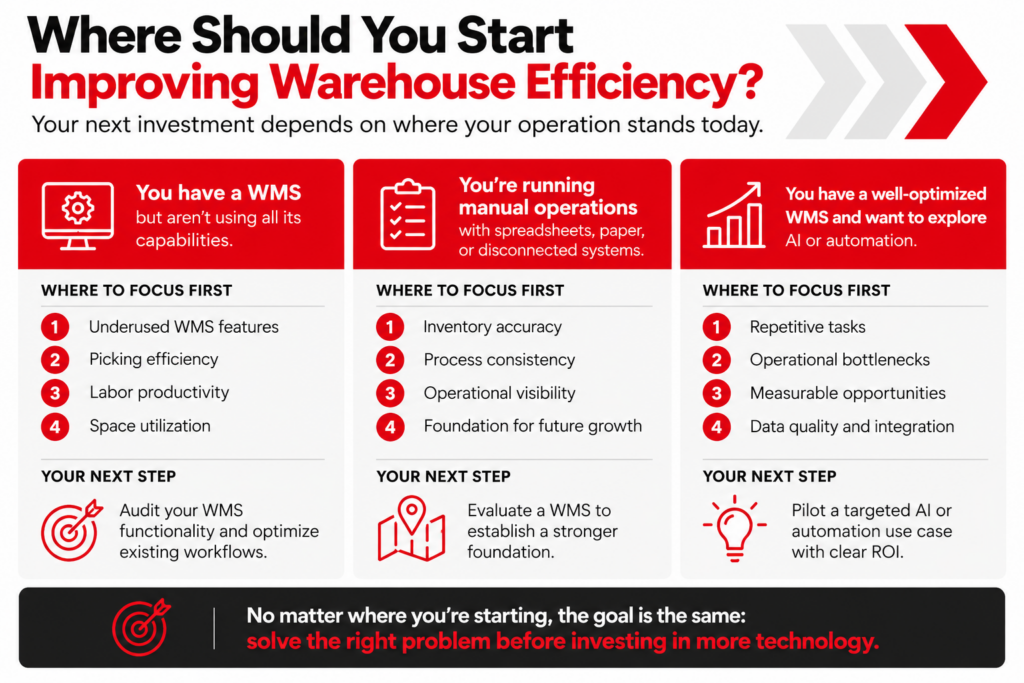
Still Running a Manual Warehouse? Your Next Step May Be a WMS
What if your warehouse doesn’t have a WMS to optimize?
If inventory is tracked in spreadsheets, orders are picked from paper lists, and employees rely on experience to determine where products belong, the first priority may be establishing better operational control.
A WMS can provide that foundation by helping warehouses:
- Track inventory and locations in real time.
- Direct receiving, putaway, picking, and shipping activities.
- Reduce manual data entry and associated errors.
- Improve order accuracy and inventory visibility.
- Capture the operational data needed to measure performance.
- Support integration with future automation and AI technologies.
That’s not to say every warehouse needs an enterprise-scale WMS or that automation must always follow a specific sequence.
The point is to match the investment to the problem.
If your biggest challenge is knowing what inventory you have and where it’s located, implementing a WMS may create more immediate value than investing in AI.
If you already have a capable WMS, the opportunity may be optimizing it.
And if your processes, data, and systems are ready, targeted automation and AI investments may be the logical next step.
Improve What You Have. Then Invest in What’s Next.
Warehouse optimization doesn’t have to begin with a major technology purchase.
Start by understanding your existing capabilities. Identify where time, space, and labor are being wasted. Fix inefficient processes and measure the results.
Then evaluate new technology against the problems you still need to solve.
At Made4net, we believe the best warehouse technology strategy starts with a clear understanding of operational needs, not a shopping list of the latest innovations.
Whether that means making better use of your current WMS, implementing your first system, or preparing for AI and automation, the goal is the same: get more value from today’s operation while building a stronger foundation for tomorrow.
Frequently Asked Questions
How can I improve warehouse efficiency without buying new technology?
Start by reviewing existing WMS functionality, warehouse slotting, pick paths, storage utilization, labor allocation, and manual workflows. Eliminating unnecessary travel, handling, and duplicate work can improve productivity without a major technology investment.
What WMS features are commonly underused?
Depending on the system, warehouses may underutilize advanced picking strategies, directed putaway, automated replenishment, cycle counting, and task interleaving. A functionality audit can help identify capabilities that are available but not fully deployed.
How can warehouses improve labor productivity without adding headcount?
Better scheduling, cross-training, workload balancing, and performance visibility can improve labor productivity. Existing WMS data can help identify opportunities, while labor management tools and gamification can support coaching, recognition, and employee engagement.
What is warehouse gamification?
Warehouse gamification uses elements such as points, leaderboards, recognition, and rewards to encourage employee engagement and performance improvement. It can use existing WMS performance data or integrate with a labor management system.
Where should warehouses start with AI?
Start with specific, measurable problems and lower-risk applications such as reporting, invoice reconciliation, customer inquiries, and document processing. Review capabilities already available from existing software providers before investing in separate AI solutions.
Should I implement a WMS before investing in warehouse automation?
For many manual operations, a WMS is an important foundation because it provides inventory visibility, coordinated workflows, and reliable operational data. The best implementation sequence depends on the warehouse’s requirements and the automation being considered.
When should a warehouse replace its existing WMS?
Consider replacement when the current system cannot support essential business processes, lacks integration capabilities, requires excessive workarounds, or cannot scale with operational needs. First determine whether configuration changes or additional use of existing features could address the problem.