Explanation of your Results:
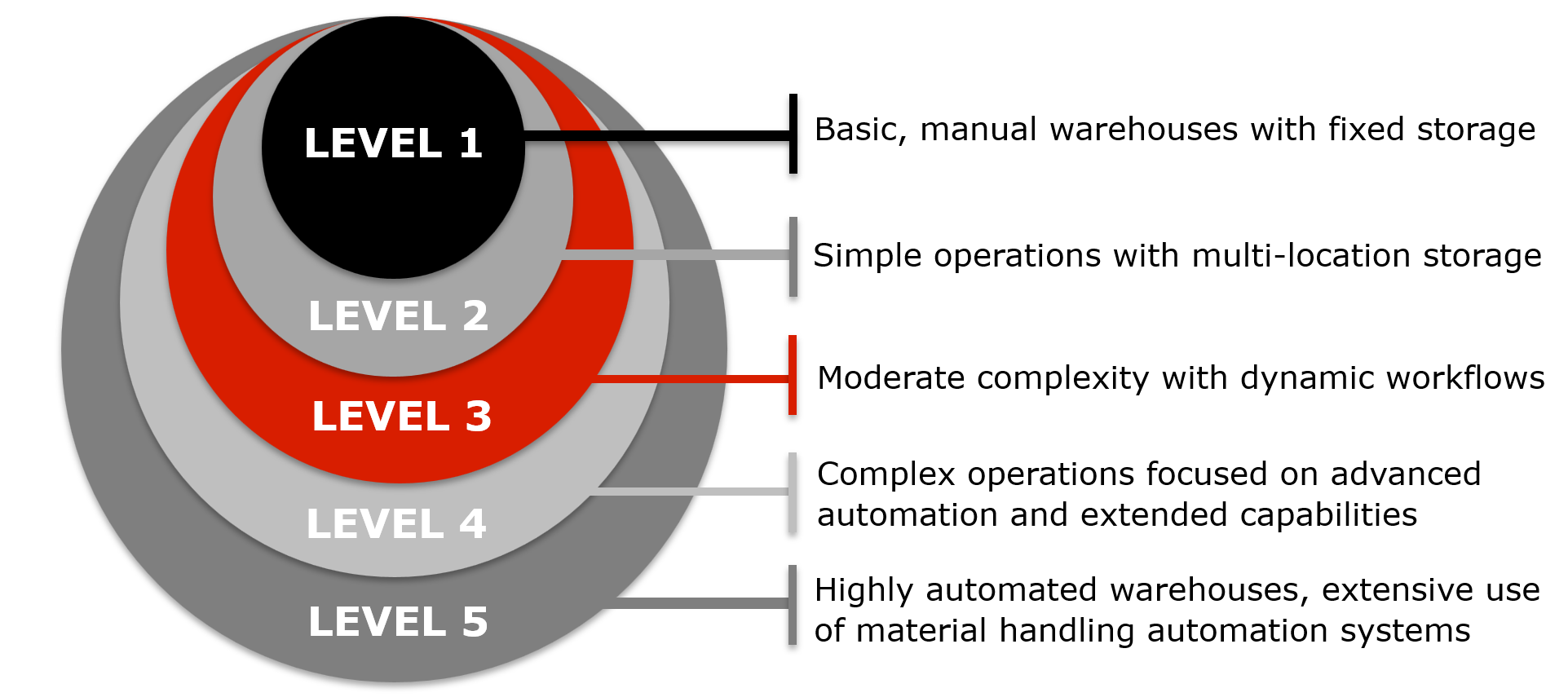
Level One Warehouse Complexity
Level 1 warehouse environments rely on basic location control and manual task execution rather than system-directed workflows. A lightweight WMS or inventory tool is often sufficient when locations are predefined and fixed, and order profiles are simple. In these settings, operations typically require only core WMS functions such as perpetual inventory, receiving, storage, picking, and shipping—but at a very limited depth.
Most WMS vendors do not focus specifically on Level 1 operations; however, many include simplified features within their broader platforms to support them. For example, a company with several Level 3 or Level 4 warehouses may also operate smaller Level 1 facilities and use a scaled-back version of its WMS to manage basic processes efficiently.
Level 1 WMS Priorities

Foundational Inventory Control
Get real-time visibility into stock levels with basic receiving, putaway, picking, and shipping tools that replace paper processes and reduce errors.
Simplicity and Ease of Use
Look for a cloud-based system with an intuitive interface, fast setup, and mobile access—so your team can get up and running quickly with minimal training.
Scalable for Growth
Choose a solution that meets today’s needs but can expand later with advanced features or integrations as your operations grow.
Cost-Effective Value
Focus on essential functionality that delivers immediate ROI through better accuracy, efficiency, and control—without unnecessary cost or complexity.
Experts Breakdown the Gartner Magic Quadrant & Critical Capabilities Reports
- WMS Evaluation – Key factors that define modern, scalable, and flexible systems.
- Technology Trends – Innovations reshaping warehouse operations and driving advantage.
- Strategic Fit – Aligning WMS capabilities with your goals and complexity.
- Expert Guidance – Industry insights to build a smarter selection strategy.
Made4net: Built to Scale as you Grow
What our customers are saying